The International Meteor Organization (IMO) was founded in 1988 and has more than 250 members now. IMO was created in response to an ever growing need for international cooperation of meteor amateur work. The collection of meteor observations by several methods from all around the world ensures the comprehensive study of meteor showers and their relation to comets and interplanetary dust.

You can read about the history, current aims and commissions of IMO. An additional page informs you about how to become a member the International Meteor Organization. Membership includes a subscription to WGN, the journal of the IMO.

Short term meteor activity outlook - Report your observations - Live ZHR graphs - Data archives - Become a member - Annual conference

Meteoroids conference in Colorado (USA), May 24-28

The Meteoroids conference is an international meeting that takes place every 3 years. It is widely attended by professional meteor astronomers, but students and amateur astronomers are also invited to participate. The next edition of the conference takes place from May 24 to 28 in Breckenridge, Colora (USA). Amateur astronomers who are members of the IMO enjoy a discount of 40% on the early registration fee! The abstract deadline is 15 January, early registration deadline is 15 February.

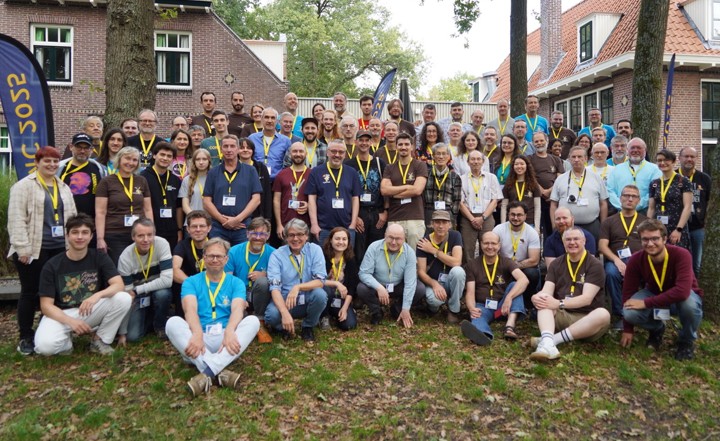
Later in the year, September 16 to 19 September, the IMO will hold its annual conference in Armagh, Northern Ireland (UK).

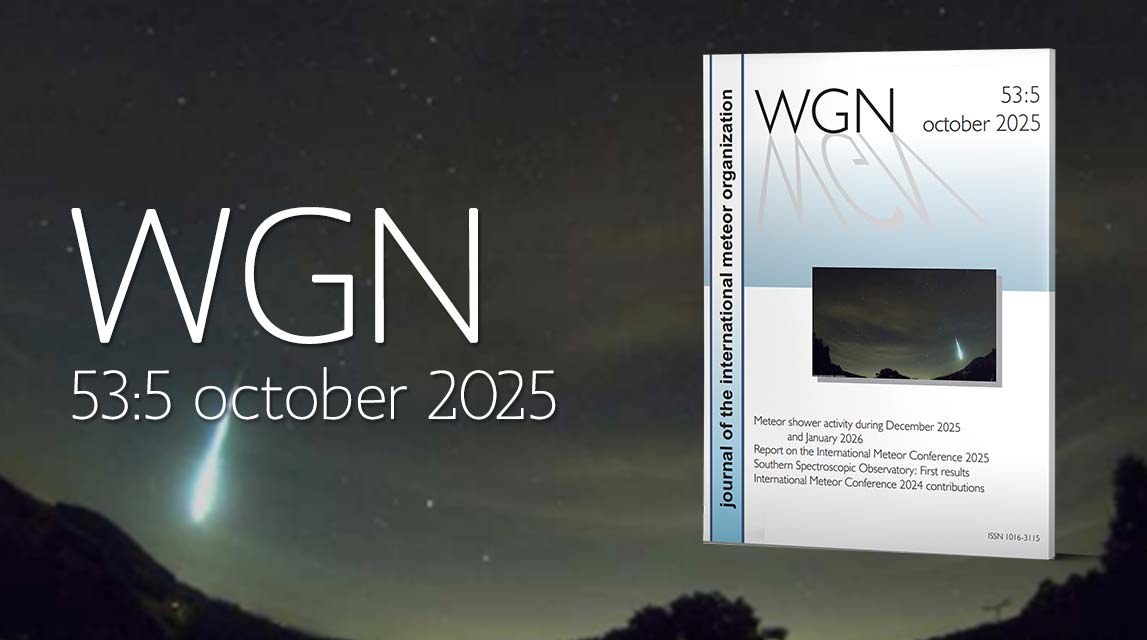
WGN Vol. 37, No. 6 out now

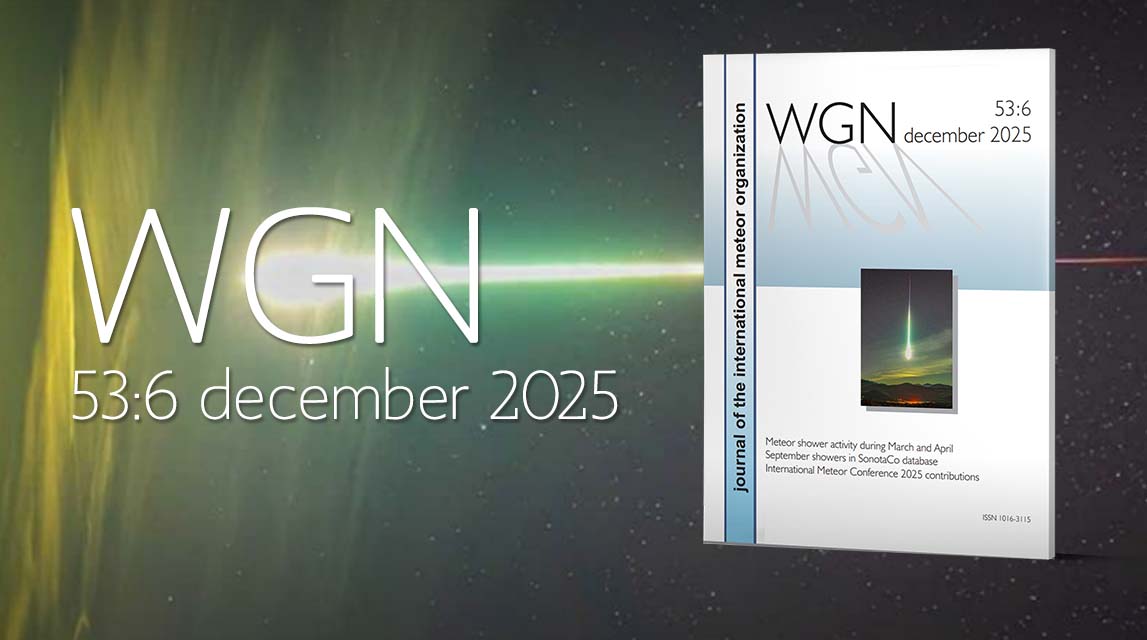
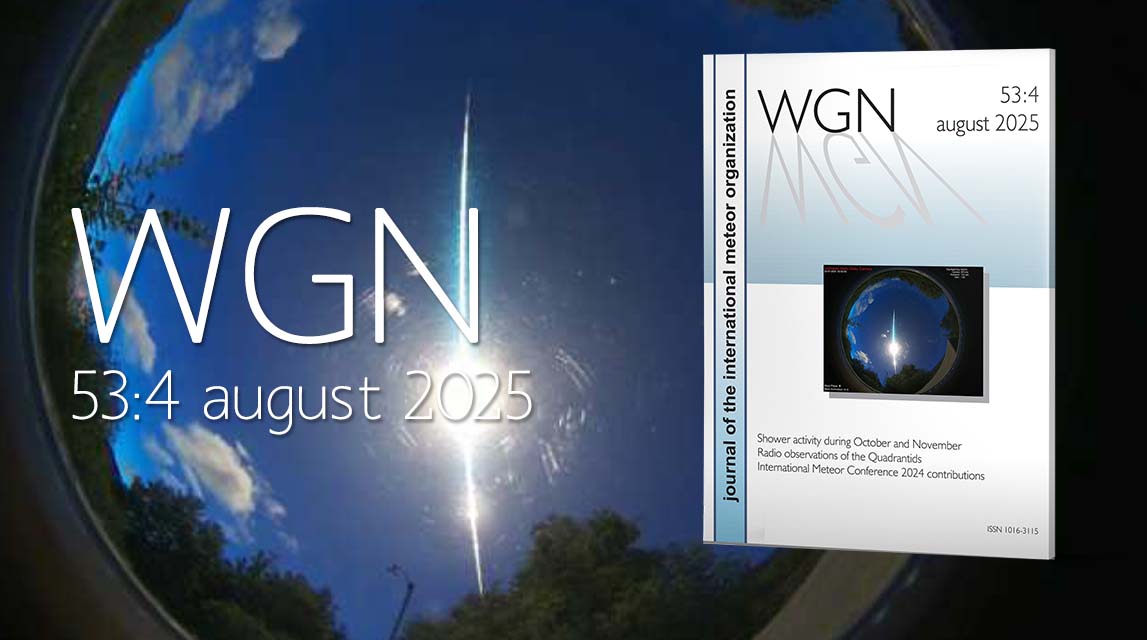
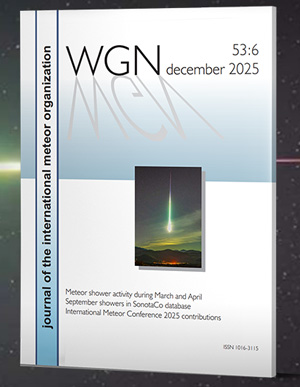
The new issue of the Journal of the International Meteor Organization is now in print. It will be posted shortly; all IMO Members and WGN subscribers should receive it soon by mail. Subscribers can also immediately access the Journal in PDF format.

If you are not a member of the International Meteor Organization yet, you can become one by filling out the electronic registration form.

Geminids 2009

First results

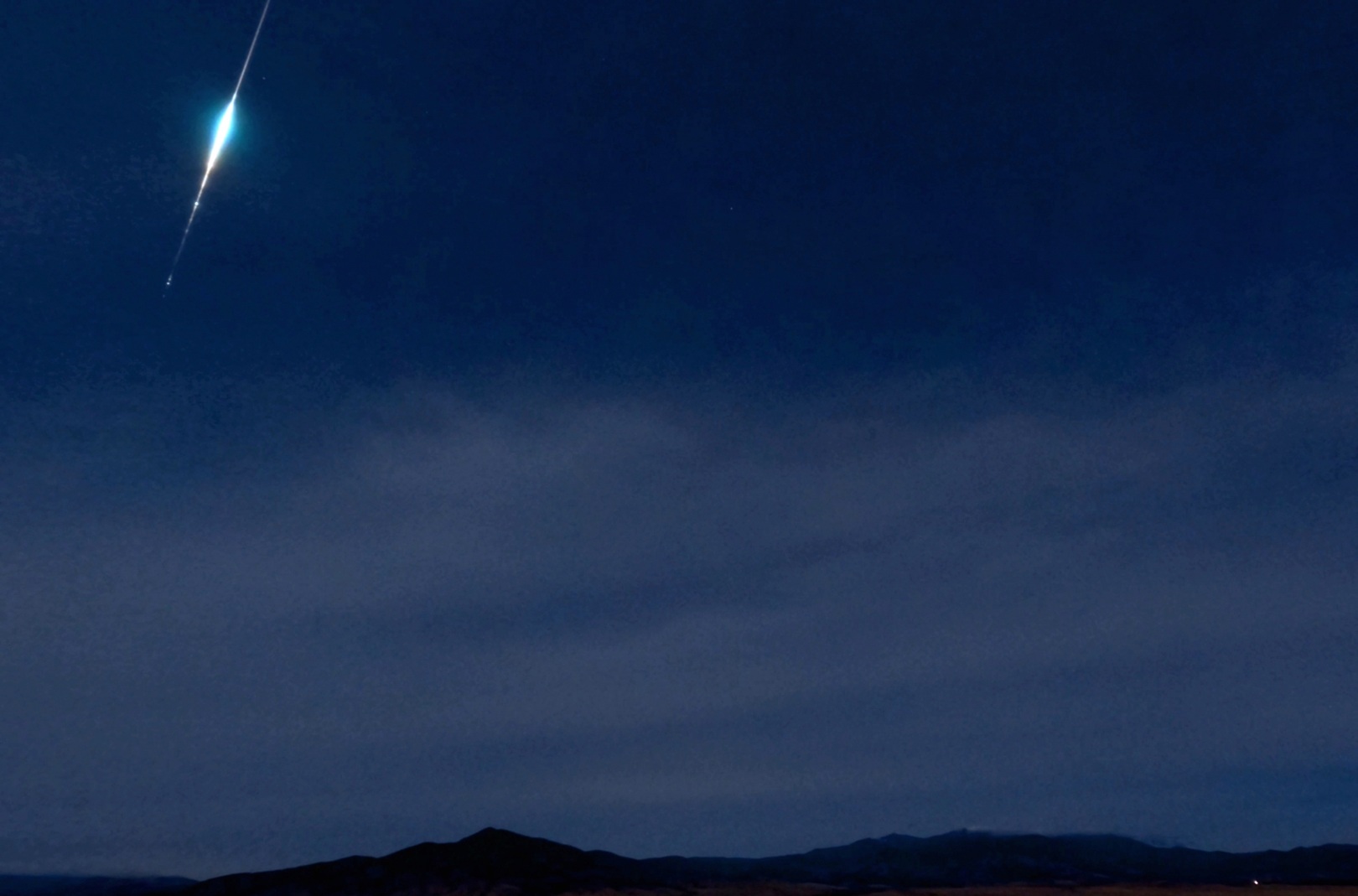
The Geminids is one of the finest, and probably the most reliable, annual meteor shower. Activity exceeds 100 meteors per hour around December 14, with meteors radiating from a point near Castor in constellation Gemini. Geminids are slow, bright and occasionally colorful. Many observers consider the shower to be more spectacular than the famous Perseids in August, but the Geminids are less widely known because of the cold and often clouded December nights in the northern hemisphere.

This year the peak is expected in the morning of December 14 (5h00 UT), coinciding with a perfect new Moon. Many tens of meteors per hour will be visible in the nights surrounding December 14, with highest rates occuring in the hours after local midnight when the radiant reaches its highest altitude in the sky. More information on the observing conditions can be found in the shower calendar.

An electronic report form is available to submit your visual observations, which will automatically be included in a ZHR activity graph. Please report short counting intervals throughout December 13-15, preferably 10 to 20 minutes, even when the activity appears low!

Leonids 2009

First results

This year may produce another enhanced return of the Leonid meteor shower, with ZHR hourly rates expected to exceed 150+ according to independent studies by Jérémie Vaubaillon, Mikhail Maslov, Esko Lyytinen, Danielle Moser, David Asher, Mikiya Sato and their respective collaborators (click the links for details). The main peak(s) are expected to occur in the night of November 17 to 18 around 22h00 UT (= 17h00 US Eastern, 23h00 Central Europe, 3h30 India, 6h00 Beijing), although variable activity may happen at almost any stage between November 16 and 18. Continuous monitoring is necessary. Leonids are generally only visible after local midnight from any longitude, with the exception of some long Earth-grazing Leonids before midnight when the radiant is still very low. Consult the shower calendar for more background.

Scientists depend strongly on visual observations by volunteers to test the theoretical models and improve future predictions. For more information on contributing your own observations, please consult the observing instructions and the instructions for filing a report. The IMO offers an electronic report form to submit your observations, and will automatically include them in the ZHR activity graph shown on the right.

Important note for visual observers: to allow for detailed analysis, please report the Leonid activity in short intervals. Try to avoid more than 5 to 10 Leonids per interval, and in any case avoid intervals longer than 10-15 minutes throughout November 17. Even when the rate is poor due to low radiant elevation or bad weather; the few meteors that you see may be part of an outburst and the exact time of their occurrence helps to determine the outburst time. Note that you can customize the number of rows in the report form or simply submit multiple forms.

Contact for observers in China with translation problems: 亚洲的观测者: 如果你有任何的问题,请联系 gba@arm.ac.uk。邮 件可以使用中文。