
News
Observing proposal: Geminids and Full Moon
Visual meteor observations under moonlit skies are usually not considered as fun because of the reduced number of meteors. Further, the smaller sample seems to limit the value of the data. Several analyses showed that there are obviously systematic effects on ZHRs calculated from data which were obtained under poor conditions, particularly if background illumination is strong. For example, the ZHRs of moonlit Perseid peaks were lower than others. It seems that the rates were not "over-corrected". Many observers probably have own experiences, such as "the sky appears dark / I still see faint stars, but I do not see faint meteors".
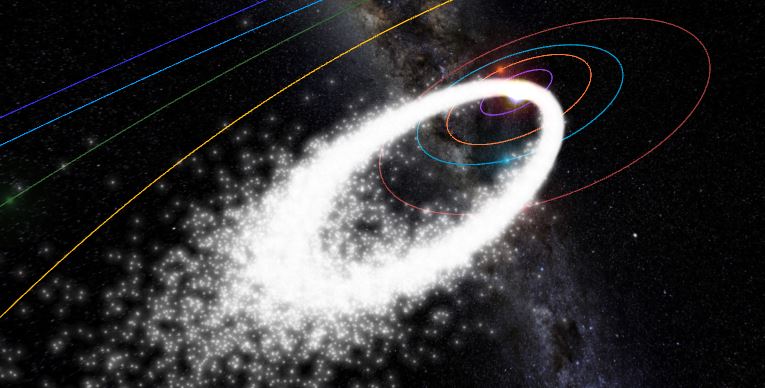
Geminids meteoroids stream. Those meteoroids are associated to an asteroid (or extinct comet), (3200) Phaeton. Credit : MeteorShowers.org
High rates during the Geminid maximum period may help to collect data to investigate the corrections. For example, video meteor data sets obtained with different limiting (stellar) magnitudes have been used to derive the population index. This also holds for visual data which have been used to test the type of magnitude distributions. The Geminids promise a reasonable data sample around their peak even if the limiting magnitude is reduced by 1-2 magnitudes. Combining many count data split into intervals of about 15 minutes seem appropriate.
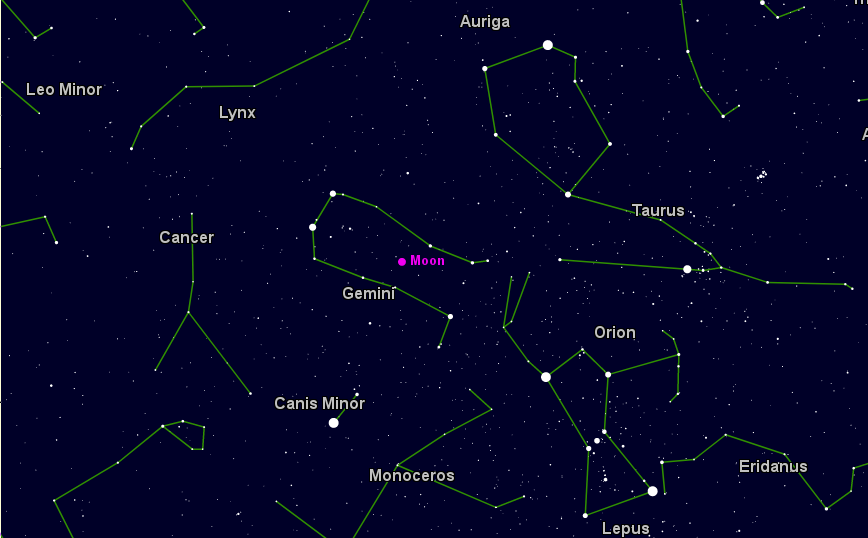
Position of the Moon during December 13-14, 2019 night. Moon is located inside the constellation of Gemini, where the Geminids radiant lies too (close to Castor).
Let us try it and hope for cloudless skies. Of course, one should shield the direct moonlight (which may be difficult due to the moon's position in the "middle of Gemini" on December 14, 01UT, shown in the chart). Some hints are given in Bob's post on the Geminids.