
News
Meteor Activity Outlook for 25-31 July 2026
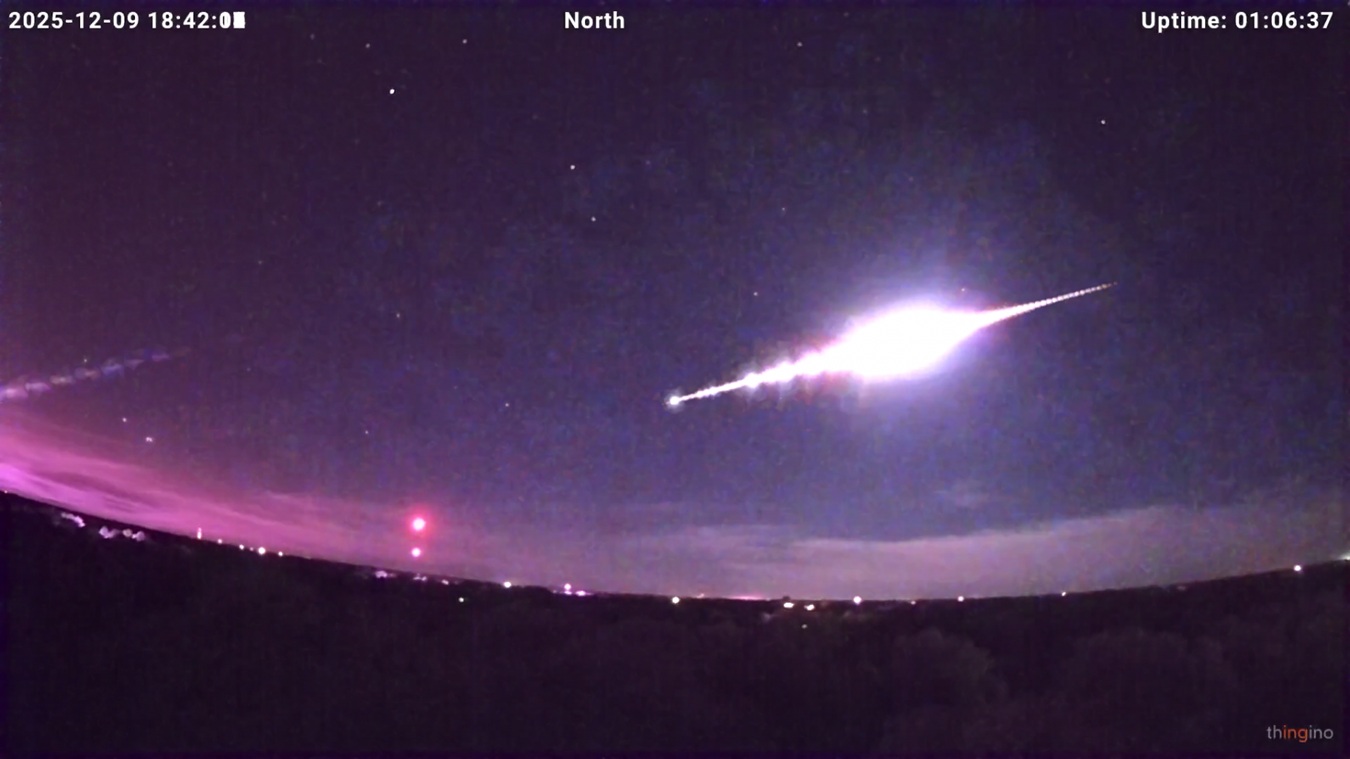
Kevin Palivec captured this stunning fireball on December 9, 2025, at 18:42 CST (00:42 UT on Dec 10) from Hawley, Texas, USA. Notice the ghost image artifact on the far left of the frame which is often seen in the brightest fireballs. ©Kevin Palivec
During this period the moon will reach its full phase on Wednesday July 29th. At that time the moon will be located opposite the sun in the sky and will lie above the horizon most of the night. This weekend the moon will set earlier enough to allow a couple of hours of dark sky viewing.
This weekend evening observers can expect total hourly rates of 3 from mid-northern latitudes (45°N) and near 3 from tropical southern locations (25°S). Morning observers may see rates near 18 from mid-northern latitudes and near 15 from tropical southern locations. Early morning and evening rates are reduced due to moonlight.
The actual rates observed will also depend on factors such as personal light and motion perception, local weather conditions, alertness, and experience in watching meteor activity. Note that the hourly rates listed below are estimates based on observations from dark-sky sites away from urban light sources. Observers viewing from urban areas will see less activity, as only the brighter meteors will be visible from such locations.
The radiant (the area of the sky from which meteors appear to originate) positions and rates listed below are exact for Saturday night/Sunday morning, July 25/26. These positions do not change greatly from day to day, so the listed coordinates may be used throughout this entire period. Most star atlases (available online, in bookstores, and at planetariums) include maps with celestial coordinate grids that can help you locate these positions in the sky.
I have also included charts of the sky that display the radiant positions for evening, midnight, and morning. The center of each chart represents the sky directly overhead at the corresponding hour. These charts are oriented towards facing south but can be used for any direction by rotating them accordingly. A planisphere or planetarium app is also useful for showing the sky at any time of night on any date of the year.
Activity from each radiant is best seen when it is positioned highest in the sky (culmination), either due north or south along the meridian, depending on your latitude. Radiants that rise after midnight will not reach their highest point until daylight; therefore, it is best to view them during the last few hours of the night.
It must be remembered that meteor activity is rarely seen directly at the radiant position. Rather, meteors shoot outward from the radiant, so it is best to center your field of view so that the radiant lies near the edge rather than the center. Viewing in this way allows you to trace the path of each meteor back to the radiant (if it belongs to a shower) or in another direction if it is sporadic. Meteor activity is not visible from radiants located far below the horizon.
The positions below are listed in west-to-east order by right ascension (celestial longitude). The positions listed first are located farther west and are therefore accessible earlier in the night, while those listed farther down the list rise later.
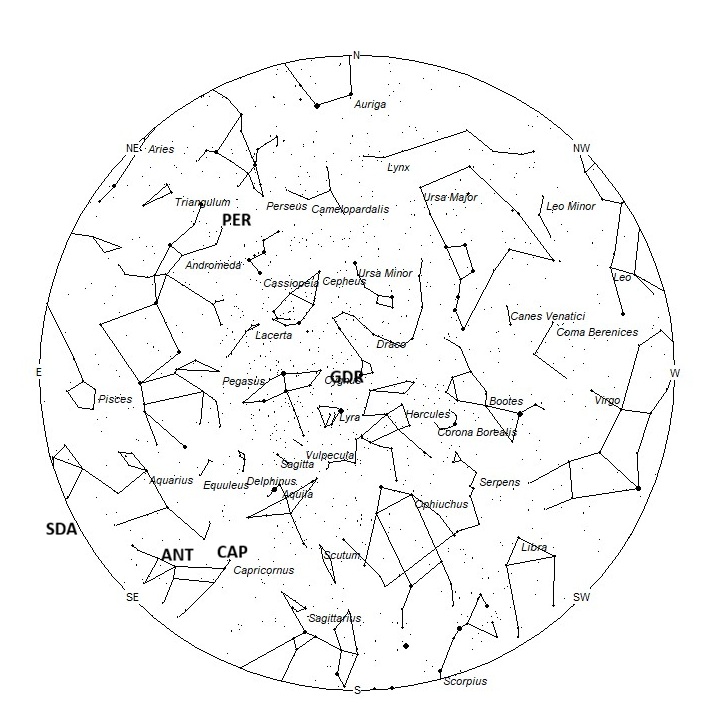
Radiant Positions at 23:00 Local Summer Time
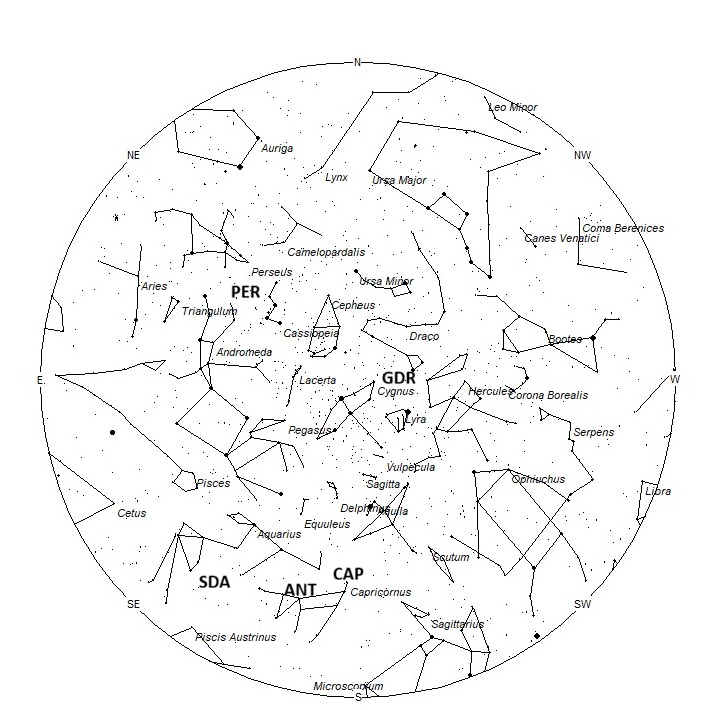
Radiant Positions at 01:00 Local Summer Time
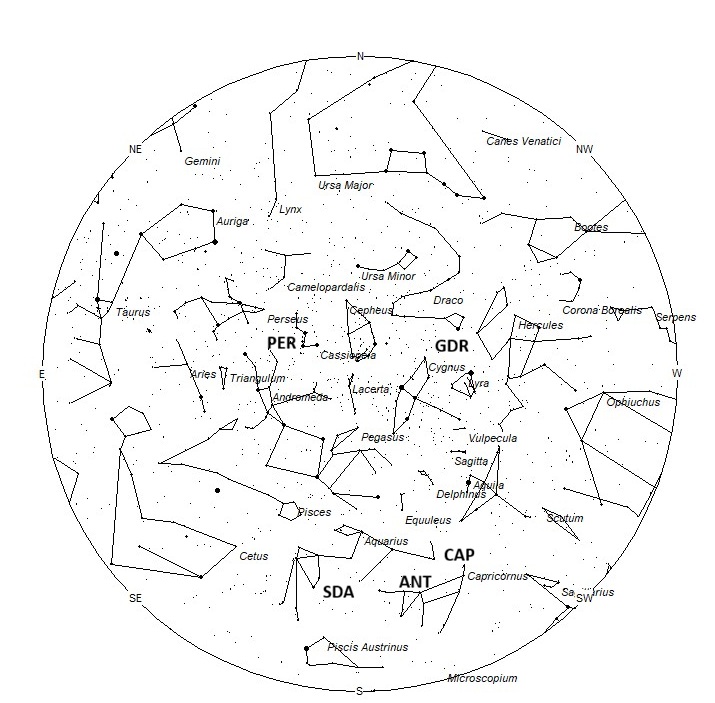
Radiant Positions at 03:00 Local Summer Time
The following sources of meteoric activity are expected to be active this week:
.
The July gamma Draconids (GDR) were first noticed by Japanese observers of SonotoCo and the IMO's network team of Sirko Molau and Juergen Rendtel in 2009. This stream is active from July 23-August 3 with maximum activity occurring on July 28. The radiant is currently located at 18:32 (278) +50, which places it in extreme southeastern Draco, 4 degrees southeast of the 2nd magnitude star known as Eltanin (gamma Draconis). The radiant also lies 11 degrees north of the brilliant zero magnitude star Vega (alpha Lyrae). These meteors are not well seen from the southern hemisphere as the radiant does not rise very high in their northern sky. Observers concentrating on this activity should face toward the northern sky near 23:00 LST best view these meteors. With an entry velocity of 27 km/sec., the average July gamma Draconid meteor would be of medium-slow velocity. In 2016, this stream produced a strong outburst that lasted approximately one hour. Nothing unusual has occurred since 2016. Some researchers feel these meteors are related to the kappa Cygnids, which are also currently active. Normal rates for this shower is less than 1 shower member per hour no matter your location and perhaps 1 per hour at maximum as seen from northern latitudes.
The alpha Capricornids (CAP) are active from July 7 through August 13, peaking on July 30th. The radiant is currently located at 20:16 (304) -11. This position lies in northwestern Capricornus, 2 degrees north of the 4th magnitude star known as Algedi (Alpha2 Capricorni). Current rates are expected to be near than 3 per hour no matter your location. These meteors are best seen near 01:00 LST, when the radiant lies highest in the southern sky. With an entry velocity of 23 km/sec., the average meteor from this source would be of medium-slow velocity.
The large Anthelion (ANT) radiant is currently centered at 21:04 (316) -15. This position lies in northern Capricornus, 2 degrees north the 4th magnitude star known as Udang (theta Capricorni A). This radiant is best placed near 01:00 LST when it lies on the meridian and lies highest in the southern sky. Rates at this time should be near 2 per hour as seen from the Northern Hemisphere and 3 per hour as seen from south of the equator. With an entry velocity of 30 km/sec., the average Anthelion meteor would be of medium-slow velocity.
The Southern delta Aquariids (SDA) are active from July 19 through August 13 with maximum activity occurring on July 30. The radiant is currently located at 22:28 (337) -17. This area of the sky is located in southern Aquarius, 4 degrees southwest of the 3rd magnitude star known as Skat (delta Aquarii). This radiant is best placed near 0400 LST, when it lies highest in the southern sky. Hourly rates at this time should be near 2 as seen from the Northern Hemisphere and 3 as seen from south of the equator. With an entry velocity of 41 km/sec., the average meteor from this source would be of medium velocity.
The Perseids (PER) are active from July 17 through August 29, with maximum activity occurring on August 13th. The radiant is currently located at 01:44 (023) +53. This position lies in northwestern Perseus 2 degrees north of the 4th magnitude star known as Dajiangjunbei (phi Persei A). This area of the sky is best placed for viewing during the last dark hour before dawn when it lies highest in the northeastern sky. Maximum activity is not until August 13th so current rates are expected to be near 3 as seen from the Northern Hemisphere and 2 as seen from south of the equator. With an entry velocity of 59 km/sec., the average meteor from this source would be of swift velocity. Viewers in the southern hemisphere have a limited view of this shower as the radiant only rises just before dawn.
Sporadic meteors are those meteors that cannot be associated with any known meteor shower. All meteor showers are evolving and disperse over time to the point where they are no longer recognizable. Away from the peaks of the major annual showers, these sporadic meteors make up the bulk of the activity seen each night.
As seen from the mid-Northern Hemisphere (45N) one would expect to see during this period approximately 10 sporadic meteors per hour during the last hour before dawn as seen from rural observing sites. Evening rates would be near 2 per hour. As seen from the tropical southern latitudes (25S), morning rates would be near 6 per hour as seen from rural observing sites and 2 per hour during the evening hours. Early morning and evening rates are reduced by moonlight.
The list below provides information in tabular form on active showers within reach of the visual observer.
Rates and positions on the table are exact for Saturday night/Sunday morning July 25/26.
SHOWER | DATE OF MAXIMUM | CELESTIAL POSITION | ENTRY VELOCITY | CULMINATION | HOURLY RATE | CLASS |
ACTIVITY | RA (RA in Deg.) DEC | Km/Sec | Local Daylight Savings Time | North-South | ||
July gamma Draconids (GDR) | Jul 28 | 18:32 (278) +50 | 27 | 00:00 | <1 - <1 | II |
alpha Capricornids (CAP) | Jul 31 | 20:16 (304) -11 | 23 | 01:00 | 3 - 3 | II |
Anthelion (ANT) | _ | 21:04 (316) -15 | 30 | 02:00 | 1 - 2 | II |
Southern delta Aquariids (SDA) | Jul 31 | 22:28 (337) -17 | 41 | 04:00 | 2 - 3 | I |
Perseids (PER) | Aug 13 | 01:44 (023) +53 | 59 | 06:00 | 3 - 2 | I |
Class Explanation: A scale to group meteor showers by their intensity:
Class I: the strongest annual showers with Zenith Hourly Rates normally ten or better.
Class II: reliable minor showers with ZHR’s normally two to ten.
Class III: showers that do not provide annual activity. These showers are rarely active yet have the potential to produce a major display on occasion.
Class IV: weak minor showers with ZHR’s rarely exceeding two. The study of these showers is best left to experienced observers who use plotting and angular velocity estimates to determine shower association. These weak showers are also good targets for video and photographic work. Observers with less experience are urged to limit their shower associations to showers with a rating of I to III.