
News
Listen to the sound of Sep. 9 meteorite fall!
Did you ever imagine the sound a meteorite would make while falling on the ground? Stop dreaming! This sound was recorded, except the extraterrestrial rock did not fall on the ground, but on a table!
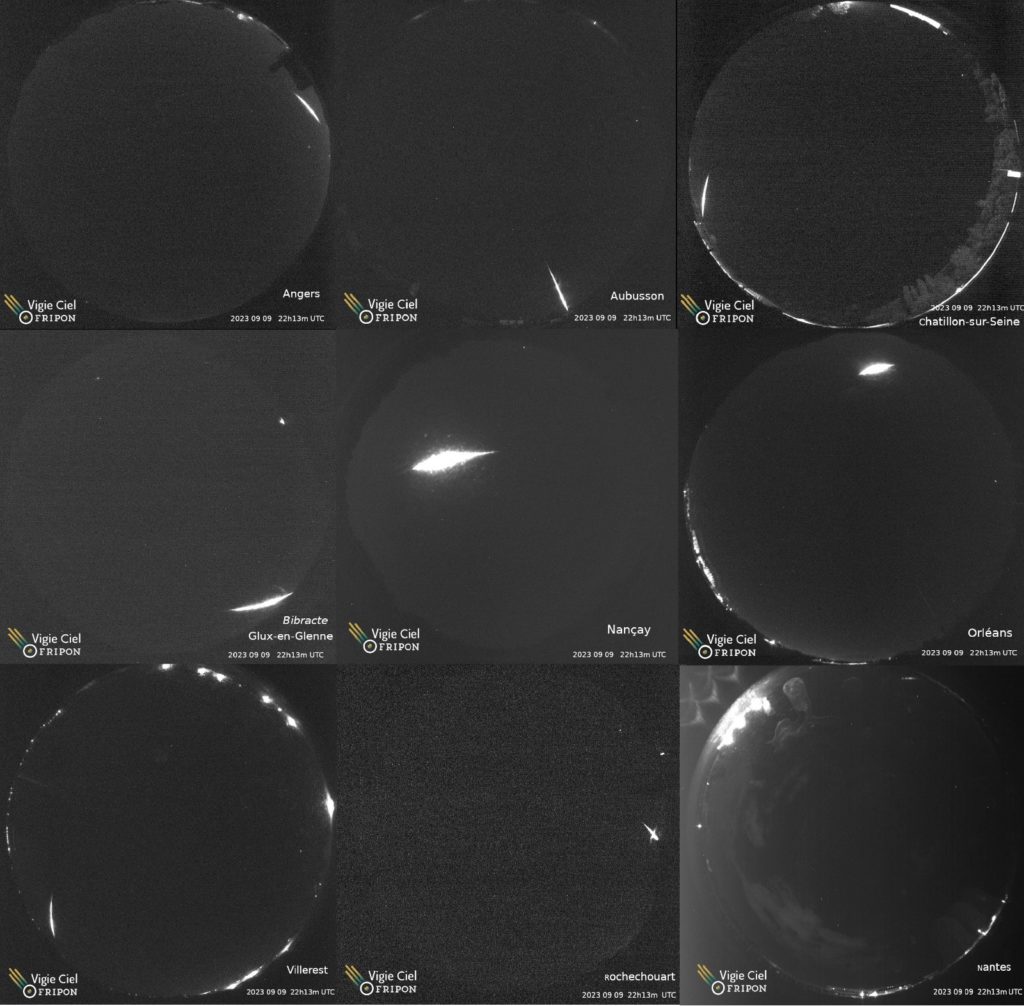
Figure 1- Mosaic of 9 pictures issued from Fripon video network recordings of the September 9th, 2023, 22h 13min UT fireball. Credit: Fripon/Vigie-Ciel
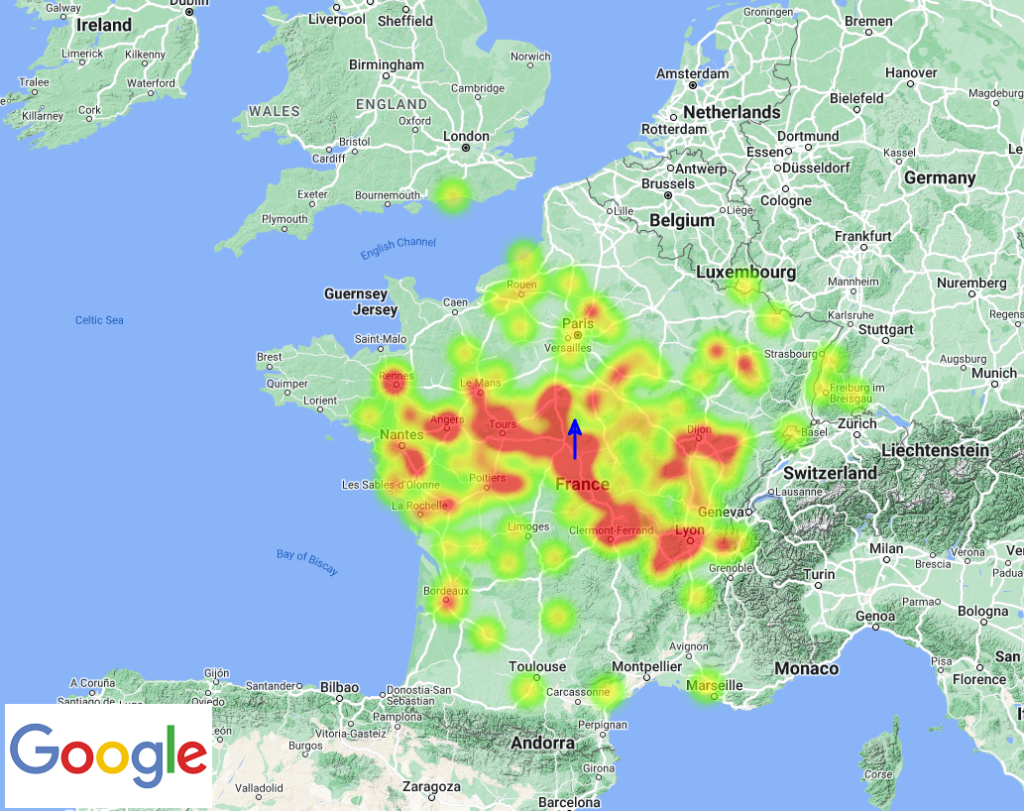
Figure 2- Heatmap of the hundreds of witnesses that reported the September 9th, 2023, 22h 13min UT fireball (Event #5231-2023). Blue arrow is the automatic calculated trajectory of the fireball deduced from visual reports. Credit: IMO/AMS
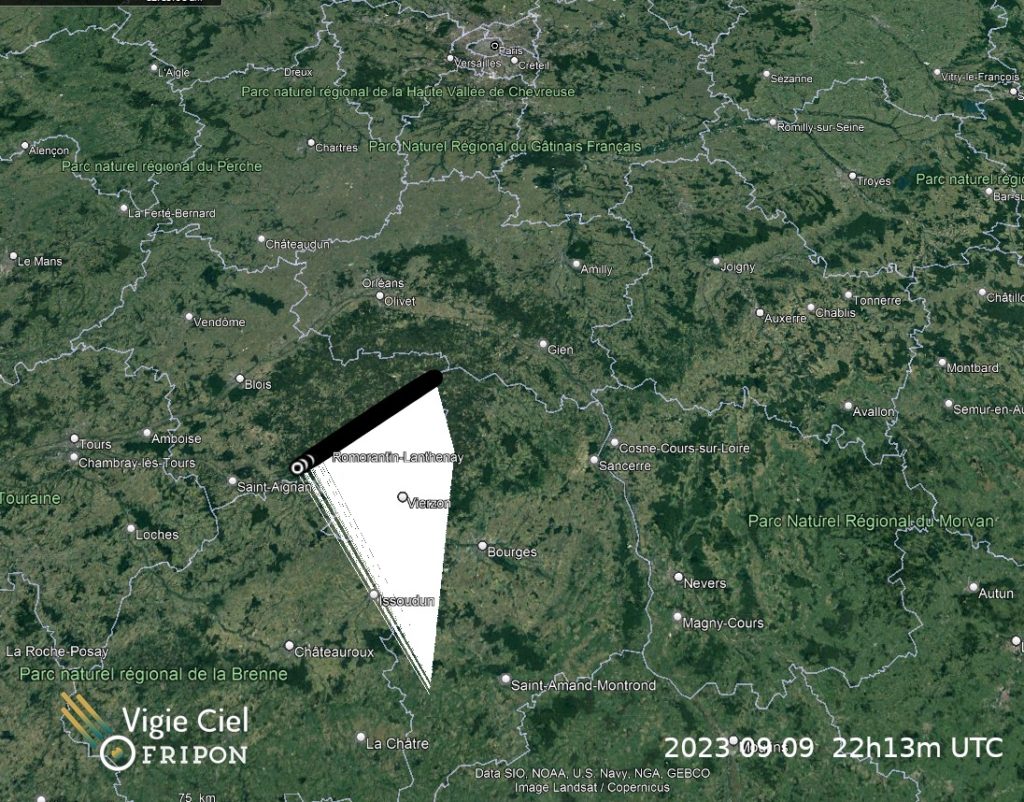
Figure 3- Trajectory of the meteoroid automatically calculated from the Fripon video network recordings. Credit: Fripon/Vigie-Ciel
A widely observed bright fireball on September 9, 2023
Actually, a -10 mag. fireball (Event #5231-2023) was widely observed from France, Great Britain, Germany, Luxemburg, Switzerland and Italy on September 9th, 2023, at 22h 13min UT (Figure 2). It was also detected by Fripon (Fireball Recovery and InterPlanetary Observation Network, Figure 1) and BOAM (Meteor Observer Database) French video networks. Calculations were conducted by a Fripon/Vigie-Ciel team to analyze videos and calculate the dark flight of the meteoroid on the last kilometers of the trajectory, as a meteorite fall was possible. The meteor was visible during a 80 km path above the Cher department, with a nearly perfect South to North direction. It entered the atmosphere at 17 km/s and with a 41° antry angle relative to the horizontal (Figure 3). The meteoroid seemed to originate from the outer parts of the asteroid belt, and the landing zone was located near Nancay, in the Cher department.
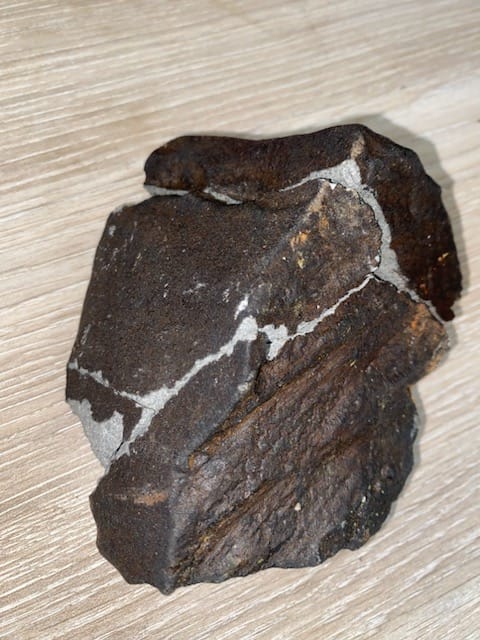
Figure 4- Reconstituted broken meteorite: the interplanetary object broke in 3 parts while hitting table corner. Credit: Fripon/Vigie-Ciel
The sound of a meteorite hitting a table
On Tuesday, September 12th morning, before calculations were finalized, the team was contacted by the Starry pole of Nancay, who received the call of an inhabitant of Sauldre and Sologne collectivity, and who thought she had found meteorites in her propriety (Figure 4). And from their first analyses, they really looked like meteorites! Fripon/Vigie-Ciel team immediately went to the indicated place to meet the discoverer, explained the phenomenon she witnessed (she heard the meteorite fall, and discovered the rock the following morning), and answered her questions. From this discussion, a nice meteorite fragment was left to the National Museum of Natural History for analyses. And rare recording, the sound of the meteorite falling on the witness table was recorded by a CCTV camera!
[video mp4="https://www.imo.net/wp-content/uploads/2023/09/AUD-20230912-WA0029.mp4"][/video]
More information to come after the meteorite analyses. The second meteorite recovery in France for 2023, after 2023 CX1 fragments recovery!
Reference
Vigie-Ciel, Une nouvelle météorite française !