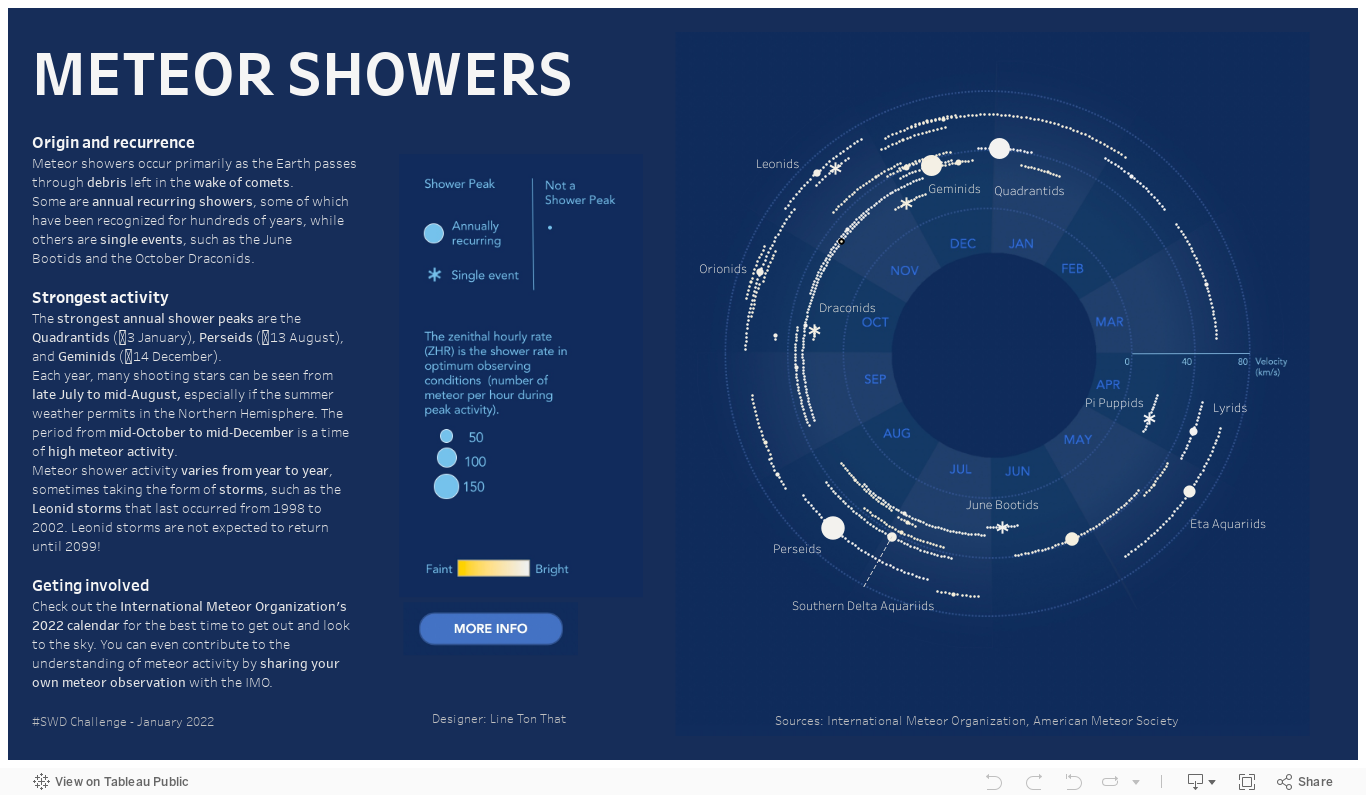
IMO Meteor Shower Calendar 1997

compiled by Alastair McBeath based on data in IMO Monograph No.2: Handbook for Visual Meteor Observers, edited by Jürgen Rendtel, Rainer Arlt and Alastair McBeath, IMO, 1995, and contributions from Paul Roggemans. Layout by André Knöfel. Prepared for UseNet, CompuServe and AstroNet by André Knöfel prepared for WWW by Sirko Molau IMOs Meteor Shower Calendar for 1997 contains the following items:

Introduction

Welcome to the 1997 International Meteor Organization (IMO) Meteor Shower
Calendar. In response to suggestions from radio workers, we have included
information on the predicted timing of the more active night-time and
daytime shower maxima this year, based on the best available data. It
should be noted, however, that in many cases, such maxima are not known
more precisely than to the nearest 1deg of solar longitude (even less
accurately for the daytime radio showers, which have received little
attention in recent years), and variations in individual showers from year
to year mean past returns are at best only a guide as to when even major
shower peaks can be expected. In addition, several showers are known to
show particle mass-sorting within their meteoroid streams, which means that
radio, telescopic, visual and photographic meteor maxima may occur at
different times from one another, and not necessarily just in these
showers. The majority of data available are for visual shower maxima, so
this must be borne in mind when employing other observing techniques. In an
ideal world, of course, we would like to see global monitoring of the
meteor activity the Earth encounters throughout the year whenever
conditions permit, to enable us to better understand the meteoroid flux in
the near-Earth vicinity. This Calendar was devised as a means of helping
observers to deal with reality, where such protracted observing is often
not possible, in highlighting times when a particular effort may most
usefully be employed.

The heart of the Calendar is the Working List of Visual Meteor Showers,
thanks to regular analyses using the IMO's Visual Meteor Database, the
single most accurate listing available anywhere today for naked-eye meteor
observing. Even this can never be a complete list of all meteor showers,
since there are many showers which cannot be properly detected visually,
and some which only photographic, radar, telescopic, or video observations
can separate from the background sporadic meteors, present throughout the
year.

The IMO's aims are to encourage, collect, analyze, and publish combined
meteor data obtained from sites all over the globe in order to further our
understanding of the meteor activity detectable from the Earth's surface.
Results from only a few localized places can never provide such total
comprehension, and it is thanks to the efforts of the many IMO observers
worldwide since 1988 that we have been able to achieve as much as we have
to date. This is not a matter for complacency, however, since it is solely
by the continued support of many people across the whole world that our
steps towards constructing a better and more complete picture of meteor
activity near the Earth can proceed. This means that all meteor workers,
wherever they are and whatever methods they use to record meteors, should
follow the standard IMO observing guidelines when compiling their
information, and submit their data promptly to the appropriate Commission
for analysis.

Visual and photographic techniques remain popular for nightly meteor
coverage (weather permitting), although both suffer considerably from the
presence of moonlight. Telescopic observations are still less popular,
although they allow the fine detail of shower radiant structures to be
derived, and they permit very low activity showers to be accurately
detected. Video methods have been dynamically applied in the last few
years, and are starting to bear considerable fruit. These have the
advantages, and disadvantages, of both photographic and telescopic
observing, but are alreadyincreasing in importance. Radio receivers can be
utilized at all times, regardless of clouds, moonlight, or daylight, and
provide the only way in which 24-hour meteor observing can be accomplished
for most latitudes. Together, these methods cover virtually the entire
range of meteoroid sizes, from the very largest fireball-producing events
(using all-sky photographic patrols or visual observations) through to tiny
dust grains producing extremely faint telescopic or radio meteors.

However and whenever you are able to observe, we wish you all a most
successful year's work and very much look forward to receiving your data.
Clear skies!

January to March

The first quarter of the year brings primarily low activity showers,
including the first of the year's main diffuse ecliptical stream complexes,
the Virginids, active from late January to mid-April. The two better
showers, the Quadrantids, visible from the northern hemisphere in early
January, and the alpha-Centaurids, a sometimes good southern hemisphere
shower in early February, are both free from moonlight in 1997, along with
the minor delta-Cancrids in mid-January and the gamma-Normids in mid-March.
Two daylight radio peaks are due from the Capricornids/Sagittarids around
07h UT on February 1, and the -Capricornids on February 13, probably around
08h UT. Neither radio shower has been well-observed in recent times, and as
both have radiants under 10-15° west of the Sun at maximum, they cannot
be regarded as visual targets even from the southern hemisphere.

Quadrantids

Active       : January 1-5;
Maximum      : January 3, 11h UT (lambda = 283.16°);
ZHR          = 120 (can vary around 60-200);
Radiant      : alpha = 230°, delta = +49°;
Radiant drift: see Table 3;
diameter     : 5° at maximum;
V            = 41 km/s;
r            = 2.1 at maximum, but variable;
TFC          : alpha = 242°, delta = +75° and
               alpha = 198°, delta = +40° (beta>40° N);
PFC          : before 00h local time alpha = 150°, delta = +70°;
               after  00h local time alpha = 180°, delta = +40° and
               alpha = 240°, delta = +70° (beta>40° N).

Figure 1: Radiant position of the Quadrantids


The year starts well for northern hemisphere watchers, with a reasonably
good return of the Quadrantids, since the Moon will be a waning crescent
in eastern Virgo and western Libra on January 3-4, and will give its worst
problems only late in the night. The shower's radiant lies in northern
Bootes, which makes it circumpolar for many northern locations, but it
attains a useful elevation for observations only after local midnight or
so, and is at its highest towards morning twilight. It is an interesting
challenge to try spotting the occasional long-pathed shower member from the
southern hemisphere around dawn, but sensible watching cannot be carried
out from such locations.

The maximum time given above is based on the best-observed return of the
shower ever analysed, from IMO 1992 data, a repeat of which time in 1997
would be excellent news for North American watchers. The peak itself is
short-lived, and can be easily missed in just a few hours of poor winter
weather in the north, which may be why the ZHR level apparently fluctuates
from year to year, but some genuine variability is probably present too. An
added level of complexity comes from the fact that mass-sorting of
particles across the meteoroid stream makes fainter objects (radio and
telescopic meteors) reach maximum up to 14 hours before the brighter
(visual and photographic) ones, so observers should be alert throughout the
shower!

Past observations have suggested the radiant is very diffuse away from the
maximum, contracting notably during the peak itself, although this may be a
result of the very low activity normally seen away from the hours near
maximum. Photographic observations from January 1-6 would be particularly
welcomed by those investigating this topic, using the PFCs given above,
along with telescopic, video and visual plotting results.

delta-Cancrids

Active       : January 1-24;
Maximum      : January 17 (lambda = 297°);
ZHR          = 4;
Radiant      : alpha = 130°, delta = +20°;
Radiant drift: see Table 3;
size         : alpha = 20° x delta = 10°;
V            = 28 km/s;
r            = 3.0;
TFC          : alpha = 115°, delta = +24° and
               alpha = 140°, delta = +35° (beta>40° N);
               alpha = 120°, delta = -03° and
               alpha = 140°, delta = -03° (beta<40° N).

Figure 2: Radiant position of the delta-Cancdrids


This minor stream is especially suited to telescopic observations, with its
large, complex radiant area that may consist of several sub-centers, and
many of its meteors are faint. It is likely that this shower is an early
part of the Virginid activity, which generally becomes more obvious in
March and April. The delta-Cancrid ZHR is unlikely to rise much above 3-4,
but the long winter nights in the northern hemisphere provide a good
opportunity to see what occurs, particularly this year, with the Moon at
first quarter for the shower's peak. The radiant is above the horizon for
almost the entire night, whether your site is north or south of the
equator, with moonset around local midnight.

alpha-Centaurids

Active       : January 28-February 21;
Maximum      : February 7, 10h UT (lambda = 318.7°);
ZHR          = variable, usually around 6, but may reach 25+;
Radiant      : alpha = 210°, delta = 59°;
Radiant drift: see Table 3;
radius       : 4°;
V            = 56 km/s;
r            = 2.0.

Figure 3: Radiant position of the alpha-Centaurids


The alpha-Centaurids are one of the main southern hemisphere high points in
the opening months of the year, producing many very bright, even fireball-
class objects (meteors of at least magnitude -3). Their peak ZHR is normally
around 5-10, but in 1974 and again in 1980, bursts of only a few hours
duration that yielded activity closer to 20-30 were detected. As we have no
means of telling when another such event might happen, photographic,video
and visual observers are urged to be alert, especially this year, since the
new Moon on February 7 perfectly favours the maximum. Thanks to their
brilliance, even a normal alpha-Centaurid return is worth looking out for,
and almost one-third routinely leave fine persistent trains after them. The
radiant is nearly circumpolar for much of the sub-equatorial Earth, and is
at a useful elevation from late evening onwards.

gamma-Normids

Active       : February 25-March 22;
Maximum      : March 13, (lambda = 353°);
ZHR          = 8;
Radiant      : alpha = 249°, delta= -51°;
Radiant drift: see Table 3;
radius       : 5°;
V            = 56 km/s;
r            = 2.4;
TFC          : alpha = 225°, delta = -26° and
               alpha = 215°, delta = -45° (beta< 15° S).

Figure 4: Radiant position of the gamma-Normids


gamma-Normid meteors are very similar to the sporadics in appearance, and
for most of their activity period, their ZHR is virtually undetectable
above this background rate. The peak itself is normally quite sharp, with
ZHRs of 3+ noted for only a day or two to either side of the maximum. There
are suggestions that the activity may vary somewhat at times, with
occasional broader, or less obvious, maxima having been reported in the
past. Post-midnight watching yields best results, when the radiant is
rising to a reasonable elevation from southern hemisphere sites, which is
good news in 1997, as the Moon is a waxing crescent that will have set long
before this time on March 13. All forms of observation can be carried out
for them, although most northern observers will see nothing from the
shower.

April to June

Meteor activity picks up around the April-May boundary, with showers like the Lyrids, pi-Puppids and eta-Aquarids, albeit only this latter source is free from moonlight this year. For radio observers, the expected UT maxima for the April showers are as follows: April Piscids (possibly periodic daylight shower) -- April 20d 07h; Lyrids -- April 22d 03h; pi-Puppids -- April 23d 14h; delta-Piscids (very short daylight shower) -- April 24d 07h. During May and June, most of the activity is in the daytime sky, with six shower peaks due in this time. Although a few shower members from the o-Cetids and Arietids have been reported from tropical and southern hemisphere sites visually in previous years, sensible activity calculations cannot be carried out from such observations. These daylight showers have the following predicted UT maximum times in 1997: epsilon-Arietids -- May 9d 05h; May Arietids -- May 16d 06h; o-Cetids -- May 20d 05h; Arietids -- June 7d 09h; zeta-Perseids -- June 9d 08h; beta-Taurids -- June 28d 08h. The ecliptical complexes continue with some late Virginids and the best from the minor Sagittarids in May-June.

eta-Aquarids

Active       : April 19-May 28;
Maximum      : May 5, 22h UT (lambda = 45.5°);
ZHR          = 60 (occasionally variable);
Radiant      : alpha = 338°, delta = -01°;
Radiant drift: see Table 3;
radius       : 4°;
V            = 66 km/s;
r            = 2.7;
TFC          : alpha = 319°, delta = +10° and
               alpha = 321°, delta = -23° (beta<20° S).

Figure 5: Radiant position of the eta-Aquarids


This is a fine, rich stream associated with Comet 1P/Halley, like the
Orionids of October, but it is visible for only a few hours before dawn
essentially from tropical and southern hemisphere sites. Occasional meteors
have been reported from further north, and the shower would benefit from
increased observer activity generally. The fast and often bright meteors
make the wait for radiant-rise worthwhile, and many events leave glowing
persistent trains after them. A relatively broad maximum -- sometimes with
a variable number of submaxima -- usually occurs in early May, and ZHRs are
generally above 30 for almost a week centred on the main maximum, based on
IMO observations between 1988-1995. With new Moon on May 6, the shower is
ideally-placed for watchers in 1997. All forms of observing can be used to
study it, with radio work allowing activity to be followed even from
northern sites throughout the daylight morning hours. The radiant
culminates at about 08h local time.

July to September

Minor shower activity continues apace from near-ecliptic sources throughout
this quarter, first from the Sagittarids, then the Aquarid and Capricornid
showers (discussed below with the Piscis Austrinids; only the Northern
iota-Aquarid maximum loses out particularly to moonlight this year), and
finally the Piscids into September. Other low activity showers are apparent
too, such as the Pegasids and July Phoenicids, but the kappa-Cygnids lose
out to the near-full Moon on August 17. Then there are the Aurigid showers
from late August through to October. The major northern hemisphere event is
always the Perseids in August, of course. For daylight radio observations,
the interest of May-June has waned, but there remains the visually-
inaccessible gamma-Leonids (peak due August 25d 08h UT), and a tricky
visual shower, the Sextantids (maximum expected September 27d 08h UT). The
latter has the waning crescent Moon near its radiant at maximum in 1997,
and will rise less than an hour before dawn in either hemisphere.

Pegasids

Active       : July 7-13;
Maximum      : July 10 (lambda = 108°);
ZHR          = 3;
Radiant      : alpha = 340°, delta = +15°;
Radiant drift: see Table 3;
radius       : 5°;
V            = 70 km/s;
r            = 3.0;
TFC          : alpha = 320°, delta = +10° and
               alpha = 332°, delta = +33° (beta>40° N);
               alpha = 357°, delta = +02° (beta<40° N).

Figure 6: Radiant position of the Pegasids


Watching this very short-lived minor shower is not easy, as a few cloudy
nights mean its loss for visual observers, but with the Moon a waxing
crescent for its peak this year, everyone -- particularly those in the
northern hemisphere -- should attempt to cover it. The shower is best-seen
in the second half of the night, by when the Moon will have set, though the
maximum ZHR is generally low. With its swift, faint meteors, telescopic
observers should be in action too.

July Phoenicids

Active       : July 10-16;
Maximum      : July 14 (lambda = 111°);
ZHR          = variable 3-10, usually around 2;
Radiant      : alpha = 032° , delta = -48°;
Radiant drift: see Table 3;
radius       : 7°;
V            = 47 km/s;
r            = 3.0;
TFC          : alpha = 041°, delta = -39° and
               alpha = 066°, delta = -62° (beta<10° N).

Figure 7: Radiant position of the July Phoenicids


This minor shower can be seen from the southern hemisphere, from where it
only attains a reasonable elevation above the horizon after midnight. This
means 1997 is a good year to watch it, with the waxing gibbous Moon at
maximum setting as the radiant becomes more suitably--placed. Activity can
be quite variable visually, and indeed observations show it is a richer
radio meteor source (possibly also telescopically too, but more results are
needed). Recent years have brought ZHRs of around 2, when the winter
weather has allowed any coverage at all. Perhaps 1997 will be a good year
for them?

Piscis Austrinids and Aquarid/Capricornid Complex

Piscis Austrinids

Active       : July 15-August 10;
Maximum      : July 28 (lambda = 125°);
ZHR          = 5;
Radiant      : alpha = 341°, delta = -30°;
Radiant drift: see Table 3;
radius       : 5°;
V            = 35 km/s;
r            = 3.2;
TFC          : alpha = 255° to 0°, delta = 0° to +15°,
               choose pairs separated by about 30° in alpha (beta<30° N).


Southern delta-Aquarids

Active       : July 12-August 19; Maximum: July 28, 00h UT (lambda = 125°);
ZHR          = 20;
Radiant      : alpha = 339°, delta = -16°;
Radiant drift: see Table 3;
radius       : 5°; V = 41 km/s; r = 3.2;
TFC          : alpha = 255° to 0°, delta = 0° to +15°,
               choose pairs separated by about 30° in alpha (beta<30° N).

Figure 9,11: Radiant position of the Alpha Capricornids and the Southern and Northern delta-Aquarids


alpha-Capricornids

Active       : July 3-August 15;
Maximum      : July 30 (lambda = 127° );
ZHR          = 4;
Radiant      : alpha = 307°, delta = -10°;
Radiant drift: see Table 3;
radius       : 8°;
V            = 23 km/s;
r            = 2.5;
TFC          : alpha = 255° to 0°, delta = 0° to +15°,
               choose pairs separated by about 30° in alpha (beta<30° N).
PFC          : alpha = 300°, delta = +10° (beta>45° N),
               alpha = 320°, delta = -05° (beta = 0° to 45° N),
               alpha = 300°, delta = -25° (beta<0° S.)

Figure 8,10: Radiant position of the Piscis Austrinids and the Southern and Northern iota-Aquarids


Southern iota-Aquarids

Active       : July 25-August 15;
Maximum      : August 4 (lambda = 132°);
ZHR          = 2;
Radiant      : alpha = 333°, delta = -15°;
Radiant drift: see Table 3;
radius       : 5°;
V            = 34 km/s;
r            = 2.9;
TFC          : alpha = 255° to 0°, delta = 0° to +15°,
               choose pairs separated by about 30° in alpha (beta<30° N).

Northern delta-Aquarids

Active       : July 15-August 25;
Maximum      : August 8 (lambda = 136°);
ZHR          = 4;
Radiant      : alpha = 335° , delta = -05°;
Radiant drift: see Table 3;
radius       : 5°;
V            = 42 km/s;
r            = 3.4;
TFC          : alpha = 255° to 0°, alpha = 0° to +15°,
               choose pairs separated by about 30° in alpha (beta<30° N).

The Aquarids and Piscis Austrinids are all rich in faint meteors, making
them well-suited to telescopic work, although enough brighter members exist
to make visual and photographic observations worth the effort too,
primarily from more southerly sites. Radio work can be used to pick up the
Southern delta-Aquarids especially, as the most active of these showers.
The alpha-Capricornids are noted for bright -- sometimes fireball-class --
events, which, combined with their low apparent velocity, can make some of
these objects among the most impressive and attractive an observer could
wish for. A possible minor enhancement of alpha-Capricornid ZHRs to around
10 was noted in 1995 by European IMO observers, although the Southern
delta-Aquarids were the only one of these streams previously suspected of
occasional variability.

Such a concentration of radiants in a small area of sky means that
familiarity with where all the radiants are is essential for accurate
shower association for all nights being observed on. Visual watchers in
particular should plot all potential stream members seen in this region of
sky rather than trying to make shower associations in the field. The only
exception is when the Southern delta-Aquarids are near their peak, when
from southern hemisphere sites in particular, rates may become too high for
accurate plotting.

All the above listed shower maxima are reasonably free from lunar-light
interference in 1997, since all five fall between last quarter Moon in late
July and first quarter Moon in mid August. As the radiants are above the
horizon for much of the night, there is ample scope for extended observing
sessions.

Perseids

Active       : July 17-August 24;
Maxima       : August 12, 06h UT (lambda = 139.6°) and
               August 12, 18h UT (lambda = 140.1°);
ZHR          : primary peak = variable 150-400, secondary peak = 100;
Radiant      : alpha = 046°, delta = +57°;
Radiant drift: see Table 3;
radius       : 5°;
V            = 59 km/s;
r            = 2.6;
TFC          : alpha = 019°, delta = +38° and
               alpha = 348°, delta = +74° before 2h local time;
               alpha = 043°, delta = +38° and
               alpha = 073°, delta = +66° after 2h local time (beta>20° N);
PFC          : alpha = 300°, delta = +40°,
               alpha = 000°, delta = +20° or
               alpha = 240°, delta = +70° (beta>20° N).

Figure 12: Radiant position of the Perseids


The Perseids have become the single most exciting and dynamic meteor shower
in recent times, with outbursts producing EZHRs of 400+ in 1991 and 1992,
around 300 in 1993, 220 in 1994 and around 160 in 1995 at the shower's
primary maximum, which this year is expected to fall around 06h UT on
August 12. The peak may be encountered up to four hours before this time,
however, judging by past variations in the densest stream core. The return
of the Perseids' parent comet 109P/Swift-Tuttle in late 1992 was almost
certainly responsible for producing these recent outbursts, although the
material was probably laid down at the comet's previous perihelion passage,
in 1862. Whether the moon-free 1996 Perseid peak will continue the
decreasing trend in the primary maximum's rates remains to be seen as this
is written, but conditions are reasonable for trying to cover the 1997
event, as the waxing gibbous Moon will set soon after midnight for most
northern hemisphere observers on August 12, by when the shower radiant will
be at a very healthy elevation. Europe or the eastern seaboards of North
America should be the places to be, if the shower's primary peak keeps to
time. The "traditional" maximum is expected around 18h UT on August 12,
well-placed for sites in the Far East and eastern Asia particularly.

Visual and photographic observers should need little encouragement to cover
this stream, but telescopic watching near the main peak would be valuable
in confirming or clarifying the possibly multiple nature of the Perseid
radiant, something not detectable visually. Video observations would be
very helpful in this respect too. Radio data would naturally enable early
confirmation, or detection, of a perhaps otherwise unobserved outburst if
the timing proves unsuitable for land-based sites. The only negative aspect
to the shower is the impossibility of covering it from the bulk of the
southern hemisphere.

alpha- and delta-Aurigids

alpha-Aurigids

Active       : August 25-September 5;
Maximum      : August 31, 23hUT (lambda = 158.6°);
ZHR          = 10;
Radiant      : alpha = 084°, delta = +42 ;
Radiant drift: see Table 3;
radius       : 5°;
V            = 66 km/s;
r            = 2.5.
TFC          : alpha = 052°, delta = +60°,
               alpha = 043°, delta = +39° and
               alpha = 023°, delta = +41° (beta>10° S).

delta-Aurigids

Active       : September 5 - October 10;
Maximum      : September 8 (lambda = 166°);
ZHR          = 6;
Radiant      : alpha = 060° , delta = +47°;
Radiant drift: see Table 3;
radius       : 5°;
V            = 64 km/s;
r            = 3.0.
TFC          : alpha = 052°, delta = +60°,
               alpha = 043°, delta = +39° and
               alpha = 023°, delta = +41° (beta>10° S).

Figure 13: Radiant position of the alpha- and delta-Aurigids


These are both essentially northern hemisphere showers, and are in need of
more observations. Despite occurring close to one another in time, and
radiating from the same constellation, they are separate streams. The
alpha-Aurigids are the more active, with short, unusual bursts giving EZHRs
of about 30-40 in 1935, 1986 and 1994, although they have not been
regularly observed until very recently, so other outbursts may have been
missed. The delta-Aurigids produce lower rates of generally fainter
meteors, and have yet to be well-seen in more than an occasional year.

1997 provides a fine opportunity to improve our knowledge of the showers,
since new Moon on September 2 means dark skies will prevail for much of the
night for both maxima. Telescopic data to confirm the radiants -- and
possibly observe the telescopic beta-Cassiopeids simultaneously -- would be
especially useful, but photographs, video records and visual plotting would
be welcomed too. The shower radiants are at a useful elevation from roughly
23h-00h onwards, so protracted watching is distinctly possible.

October to December

Ecliptical minor shower activity reaches what might be regarded as a peak in early to mid November, with the Taurid streams in action, but before then we have the Orionids (whose central peak of several submaxima, October 21d 07h UT, is badly affected by a waning gibbous Moon, as are the minor epsilon-Geminids). Around October 9d 17h UT, any Draconid activity this year might be detected, when the Moon is at first quarter, but it is likely to be 1998, when Comet 21P/Giacobini-Zinner returns to perihelion, that we have the best chance to see any noticeable activity from this source. The Leonids (maximum due November 17, 15h UT) and the Geminids (peak: December 13, 22h UT) both lose out to bright moonlight in 1997, along with several of the late-year low-activity showers, such as the alpha-Monocerotids (those checking for another outburst at the time of 1995's should be alert around November 21d 13h UT), Monocerotids, sigma-Hydrids and Coma Berenicids. By contrast, the chi-Orionids, Phoenicids, the early part of the weak Puppid-Velid complex and Ursids during December are all rather better-placed with regard to the Moon.

Taurids

Southern Taurids

Active       : October 1-November 25;
Maximum      : November 5 (lambda = 223°);
ZHR          = 5;
Radiant      : alpha = 050°, delta = +13°;
Radiant drift: see Table 3;
size         : alpha = 20° x delta = 10°;
V            = 27 km/s;
r            = 2.3;
TFC          : Choose fields on the ecliptic and around 10° E or W of the
               radiants (beta>40° S).

Northern Taurids

Active       : October 1-November 25;
Maximum      : November 12 (lambda = 230°);
ZHR          = 5;
Radiant      : alpha = 058°, delta = +22°;
Radiant drift: see Table 3;
size         : alpha = 20° x delta = 10°;
V            = 29 km/s;
r            = 2.3;
TFC          : Choose fields on the ecliptic and around 10° E or W of the
               radiants (beta>40° S).

Figure 14: Radiant position of the Northern and Southern Taurids


These two streams forms a complex associated with Comet 2P/Encke. Defining
their radiants is best achieved by careful visual or telescopic plotting,
photography or video work, since they are large and diffuse. The brightness
and relative slowness of many shower meteors makes them ideal targets for
photography, while these factors coupled with low, steady combined Taurid
rates makes them excellent targets for newcomers to practice their plotting
techniques on. The activity of both streams produces an apparently plateau-
like maximum for about ten days in early November, and the shower has a
reputation for producing some superbly bright fireballs at times, although
seemingly not in every year. 1995 produced an impressive crop of brilliant
Taurids between late October and mid-November, for instance, and the last
few days of October with the opening ones of November seem especially
likely to yield Taurid fireballs, from past analyses. New Moon on October
31 means this period, and the Southern Taurid maximum are notably favoured
with dark skies in 1997.

The near-ecliptic radiants for both shower branches mean all meteoricists
can observe the streams, with the northern hemisphere somewhat better-
placed, from where suitable radiant zenith distances obtain for much of the
lengthening late autumnal nights. Even in the southern hemisphere, a good
3-5 hours' watching around local midnight is possible with Taurus well
above the horizon, however.

chi-Orionids

Active       : November 26-December 15;
Maximum      : December 2, (lambda = 250),
ZHR          = 3;
Radiant      : alpha = 082°, delta = +23°;
Radiant drift: see Table 3;
radius       : 8°;
V            = 28 km/s;
r            = 3.0;
TFC          : alpha = 083°, delta = +09° and
               alpha = 080°, delta = +24° (beta>30° S).

Figure 15: Radiant position of the chi-Orionids


This weak visual stream is moderately active telescopically, although a
number of brighter meteors have been recorded by professional photographic
patrols in the past too. The shower has a double radiant (at least), but
the southern branch has been rarely detected. The chi-Orionids may be a
continuation of the ecliptic complex after the Taurids cease to be active.
The radiant used here is a combined one, suitable for visual work, although
telescopic or video observations should be better-able to determine the
exact radiant structure. November's new Moon favours the shower with dark
skies this year, and the radiant, actually in eastern Taurus at the
shower's peak, is well on display for all watchers throughout the night.

Phoenicids

Active       : November 28-December 9;
Maximum      : December 6, 08h UT (lambda = 254.25°);
ZHR          = variable, usually 3 or less, may reach 100;
Radiant      : alpha = 018°, delta = -53°;
Radiant drift: see Table 3;
radius       : 5°;
V            = 18 km/s;
r            = 2.8;
TFC          : alpha = 040°, delta = 39° and
               alpha = 065°, delta = 62° (beta<10° N).

Figure 16: Radiant position of the Phoenicids


Only one impressive Phoenicid return has so far been reported, that of its
discovery in 1956, when the ZHR was around 100. Three other potential
bursts of lower activity have been reported, but never by more than one
observer, under uncertain circumstances. IMO observers noted rates barely
at the visual detection limit between 1988-1995, making the normal current
activity virtually nonexistent. This may be a periodic shower, however, and
more observations of it are needed by all methods. Radio workers may find
difficulties, as radar echoes from the 1956 event were only 30 per hour,
perhaps because these low-velocity meteors produce too little radio-
reflecting ionization. Observing conditions this year are reasonable for
all southern hemisphere watchers, with a waxing crescent Moon a problem
only in the evening hours. This is a little unfortunate, since the radiant,
although well on view for most of the night, culminates at dusk, but it
should not be regarded as a major deterrent.

Ursids

Active       : December 17-26;
Maximum      : December 22, 11h UT (lambda = 270.7°);
ZHR          = 10 (occasionally variable up to 50);
Radiant      : alpha = 217°, delta = +76°;
Radiant drift: see Table 3;
radius       : 5°;
V            = 33 km/s;
r            = 3.0;
TFC          : alpha = 348°, delta = +75° and
               alpha = 131°, delta = +66° (beta>40° N);
               alpha = 063°, delta = +84° and
               alpha = 156°, delta = +64° (beta 30° to 40° N);

Figure 17: Radiant position of the Ursids


A northern hemisphere shower which has been very poorly-observed, although
at least two major outbursts have occurred in the past half-century or so,
in 1945 and 1986, and several other rate enhancements, recently in 1988 and
1994, have been reported too. Other similar events could easily have been
missed due to poor weather or too few observers active. All forms of
observation can be used for the shower, since many of its meteors are
faint, but with so little work carried out on the stream, it is impossible
to be precise in making statements about it.

Its radiant is circumpolar from most northern sites (thus fails to rise for
most southern ones), though it culminates after daybreak, and is highest in
the sky later in the night. The waning Moon, just past last quarter, will
be a minor nuisance this year when the radiant is approaching its highest,
but with observations at a premium, that should not put off prospective
watchers.

Abbreviations

alpha, delta: Coordinates for a shower's radiant position, usually at
maximum; is right ascension, is declination. Radiants drift across the
sky each day due to the Earth's own orbital motion around the Sun, and
this must be allowed for using the details in Table 3 for nights away
from the listed shower maxima.

r: Population index, a term computed from each shower's meteor magnitude
distribution. r = 2.0-2.5 is brighter than average, while r above 3.0 is
fainter than average.

lambda: Solar longitude, a precise measure of the Earth's position on its
orbit which is not dependent on the vagaries of the calendar. All lambda are
given for the equinox 2000.0.

v: Atmospheric or apparent meteoric velocity given in km/s. Velocities range
from about 11 km/s (very slow) to 72 km/s (very fast). 40 km/s is roughly
medium speed.

ZHR: Zenithal Hourly Rate, a calculated maximum number of meteors an ideal
observer would see in a perfectly clear skies with the shower radiant
overhead. This figure is given in terms of meteors per hour. Where meteor
activity persisted at a high level for less than an hour, or where
observing circumstances were very poor, an estimated ZHR (EZHR) is used,
which is less accurate than the normal ZHR.

TFC and PFC: suggested telescopic and photographic field centers
respectively. beta is the observer's latitude ("<" means "south of" and ">"
means "north of"). Pairs of telescopic fields must be observed, alternating
about every half hour, so that the positions of radiants can be defined. The
exact choice of TFC or PFC depends on the observer's location and the
elevation of the radiant.


Tables

Table 1: Lunar phases for 1997.

New           First          Full           Last
Moon          Quarter        Moon           Quarter
                                            January 2
January 9     January 15     January 23     January 31
February 7    February 14    February 22    March 2
March 9       March 16       March 24       March 31
April 7       April 14       April 22       April 30
May 6         May 14         May 22         May 29
June 5        June 13        June 20        June 27
July 4        July 12        July 20        July 26
August 3      August 11      August 18      August 25
September 2   September 10   September 16   September 23
October 1     October 9      October 16     October 23
October 31    November 7     November 14    November 22
November 30   December 7     December 14    December 21
December 29


Table 2: Working list of visual meteor showers. Details in this Table
correct according to the best information available in April 1996. Contact
the IMO's Visual Commission for more information. Maximum dates in
parentheses indicate reference dates for the radiant, not true maxima. Some
showers have ZHRs that vary from year to year. The most recent reliable
figure is given here, except for possibly periodic showers that are noted
as "var." = variable.

Shower                    Activity          Maximum         Radiant
                           Period         Date  lambda   alpha delta
                                                  °        °     °
Quadrantids             Jan 01-Jan 05    Jan 03  283.16   230   +49
delta-Cancrids          Jan 01-Jan 24    Jan 17  297      130   +20
alpha-Centaurids        Jan 28-Feb 21    Feb 07  318.7    210   -59
delta-Leonids           Feb 15-Mar 10    Feb 24  336      168   +16
gamma-Normids           Feb 25-Mar 22    Mar 13  353      249   -51
Virginids               Jan 25-Apr 15   (Mar 24)(004)     195   -04
Lyrids                  Apr 16-Apr 25    Apr 22  032.1    271   +34
pi-Puppids              Apr 15-Apr 28    Apr 23  033.5    110   -45
eta-Aquarids            Apr 19-May 28    May 05  045.5    338   -01
Sagittarids             Apr 15-Jul 15   (May 19)(059)     247   -22
Pegasids                Jul 07-Jul 13    Jul 10  108      340   +15
July Phoenicids         Jul 10-Jul 16    Jul 13  111      032   -48
Pisces Austrinids       Jul 15-Aug 10    Jul 28  125      341   -30
Southern delta-Aquarids Jul 12-Aug 19    Jul 28  125      339   -16
alpha-Capricornids      Jul 03-Aug 15    Jul 30  127      307   -10
Southern iota-Aquarids  Jul 25-Aug 15    Aug 04  132      334   -15
Northern delta-Aquarids Jul 15-Aug 25    Aug 08  136      335   -05
Perseids                Jul 17-Aug 24    Aug 12  139.6    046   +58
kappa-Cygnids           Aug 03-Aug 25    Aug 17  145      286   +59
Northern iota-Aquarids  Aug 11-Aug 31    Aug 19  147      327   -06
alpha-Aurigids          Aug 25-Sep 05    Aug 31  158.6    084   +42
delta-Aurigids          Sep 05-Oct 10    Sep 08  166      060   +47
Piscids                 Sep 01-Sep 30    Sep 19  177      005   -01
Draconids               Oct 06-Oct 10    Oct 09  196.49   262   +54
epsilon-Geminids        Oct 14-Oct 27    Oct 18  205      102   +27
Orionids                Oct 02-Nov 07    Oct 21  208      095   +16
Southern Taurids        Oct 01-Nov 25    Nov 05  223      052   +13
Northern Taurids        Oct 01-Nov 25    Nov 12  230      058   +22
Leonids                 Nov 14-Nov 21    Nov 17  235.16   153   +22
alpha-Monocerotids      Nov 15-Nov 25    Nov 21  239.32   110   +03
chi-Orionids            Nov 26-Dec 15    Dec 02  250      082   +23
Phoenicids              Nov 28-Dec 09    Dec 06  254.25   018   -53
Puppid-Velids           Dec 01-Dec 15   (Dec 07)(255)     123   -45
Monocerotids (Dec)      Nov 27-Dec 17    Dec 08  257      100   +08
sigma-Hydrids           Dec 03-Dec 15    Dec 11  260      127   +02
Geminids                Dec 07-Dec 17    Dec 13  262.0    112   +33
Coma Berenicids         Dec 12-Jan 23    Dec 19  268      175   +25
Ursids                  Dec 17-Dec 26    Dec 22  270.7    217   +76


Shower                     v     r   ZHR  IMO
                          km/s            Code
Quadrantids                41   2.1  120  QUA
delta-Cancrids             28   3.0    4  DCA
alpha-Centaurids           56   2.0    6  ACE
delta-Leonids              23   3.0    2  DLE
gamma-Normids              56   2.4    8  GNO
Virginids                  30   3.0    5  VIR
Lyrids                     49   2.9   15  LYR
pi-Puppids                 18   2.0 var.  PPU
eta-Aquarids               66   2.7   60  ETA
Sagittarids                30   2.5    5  SAG
Pegasids                   70   3.0    3  JPE
July Phoenicids            47   3.0 var.  PHE
Pisces Austrinids          35   3.2    5  PAU
Southern delta-Aquarids    41   3.2   20  SDA
alpha-Capricornids         23   2.5    4  CAP
Southern iota-Aquarids     34   2.9    2  SIA
Northern delta-Aquarids    42   3.4    4  NDA
Perseids                   59   2.6  200  PER
kappa-Cygnids              25   3.0    3  KCG
Northern iota-Aquarids     31   3.2    3  NIA
alpha-Aurigids             66   2.5   10  AUR
delta-Aurigids             64   3.0    6  DAU
Piscids                    26   3.0    3  SPI
Draconids                  20   2.6 var.  GIA
epsilon-Geminids           70   3.0    2  EGE
Orionids                   66   2.9   20  ORI
Southern Taurids           27   2.3    5  STA
Northern Taurids           29   2.3    5  NTA
Leonids                    71   2.5  40+  LEO
alpha-Monocerotids         65   2.4 var.  AMO
chi-Orionids               28   3.0    3  XOR
Phoenicids                 18   2.8 var.  PHO
Puppid-Velids              40   2.9   10  PUP
Monocerotids (Dec)         42   3.0    3  MON
sigma-Hydrids              58   3.0    2  HYD
Geminids                   35   2.6  110  GEM
Coma Berenicids            65   3.0    5  COM
Ursids                     33   3.0   10  URS


Table 3: Radiant positions during the year in alpha and delta.

         COM     DCA
Jan 0  186 +20 112 +22   QUA
Jan 5  190 +18 116 +22 231 +49
Jan 10 194 +17 121 +21
Jan 20 202 +13 130 +19           ACE     VIR
Jan 30                         200 -57 157 +16   DLE
Feb 10                         214 -60 165 +10 155 +20   GNO
Feb 20                         225 -63 172  +6 164 +18 225 -53
Feb 28                                 178  +3 171 +15 234 -52
Mar 10                                 186   0 180 +12 245 -51
Mar 20                                 192  -3         256 -50
Mar 30                                 198  -5
Apr 10   SAG     LYR     PPU           203  -7
Apr 15 224 -17 263 +34 106 -44   ETA   205  -8
Apr 20 227 -18 269 +34 109 -45 323  -7
Apr 25 230 -19 274 +34 111 -45 328  -5
Apr 30 233 -19                 332  -4
May  5 236 -20                 337  -2
May 10 240 -21                 341   0
May 20 247 -22                 350  +5
May 30 256 -23
Jun 10 265 -23
Jun 15 270 -23
Jun 20 275 -23
Jun 25 280 -23
Jun 30 284 -23           CAP                     JPE
Jul  5 289 -22         285 -16   SDA           338 +14
Jul 10 293 -22   PHE   289 -15 325 -19   NDA   341 +15   PER     PAU
Jul 15 298 -21 032 -48 294 -14 329 -19 316 -10         012 +51 330 -34
Jul 20                 299 -12 333 -18 319  -9   SIA   018 +52 334 -33
Jul 25                 303 -11 337 -17 323  -9 322 -17 023 +54 338 -31
Jul 30   KCG           308 -10 340 -16 327  -8 328 -16 029 +55 343 -29
Aug  5 283 +58   NIA   313  -8 345 -14 332  -6 334 -15 037 +57 348 -27
Aug 10 284 +58 317  -7 318  -6 349 -13 335  -5 339 -14 043 +58 352 -26
Aug 15 285 +59 322  -7         352 -12 339  -4 345 -13 050 +59
Aug 20 286 +59 327  -6   AUR   356 -11 343  -3         057 +59
Aug 25 288 +60 332  -5 076 +42         347  -2         065 +60
Aug 30 289 +60 337  -5 082 +42   DAU
Sep  5                 088 +42 055 +46   SPI
Sep 10                         060 +47 357  -5
Sep 15                         066 +48 001  -3
Sep 20                         071 +48 005  -1
Sep 25   NTA     STA           077 +49 009   0
Sep 30 021 +11 023  +5    ORI  083 +49 013  +2
Oct  5 025 +12 027  +7 085 +14 089 +49            GIA
Oct 10 029 +14 031  +8 088 +15 095 +49          262 +54
Oct 15 034 +16 035  +9 091 +15           EGE
Oct 20 038 +17 039 +11 094 +16         099 +27
Oct 25 043 +18 043 +12 098 +16         104 +27

Oct 30 047 +20 047 +13 101 +16         109 +27
Nov  5 053 +21 052 +14 105 +17
Nov 10 058 +22 056 +15           LEO     AMO
Nov 15 062 +23 060 +16         150 +23 113  -5
Nov 20 067 +24 064 +16   XOR   153 +21 117  -6
Nov 25 072 +24 069 +17 075 +23         121  -7    MON     PUP     PHO
Nov 30                 080 +23   HYD            091  +8 120 -45 014 -52
Dec  5  COM      GEM   085 +23 122  +3          096  +8 122 -45 018 -53
Dec 10 169 +27 108 +33 090 +23 126  +2          100  +8 125 -45 022 -53
Dec 15 173 +26 113 +33 094 +23 130  +1    URS   104  +8 128 -45
Dec 20 177 +24 118 +32                  217 +75


Table 4: Working list of daytime radio meteor streams. The "Best Observed"
columns give the approximate local mean times between which a four-element
antenna at an elevation of 45° receiving a signal from a 30-kW transmitter
1000 km away should record at least 85% of any suitably positioned radio-
reflecting meteor trails for the appropriate latitudes. Note that this is
often heavily dependent on the compass direction in which the antenna is
pointing, however, and applies only to dates near the shower's maximum.

Shower             Activity     Max  lambda  Radiant  Best Observed  Rate
                                Date 2000.0 al. de.   50°N    35°S
                                        °    °   °
Cap/Sagittarids  Jan 13-Feb 04 Feb 02 312.5 299 -15  11h-14h 09h-14h medium
chi-Capricornids Jan 29-Feb 28 Feb 14 324.7 315 -24  10h-13h 08h-15h low
Piscids (Apr.)   Apr 08-Apr 29 Apr 20 030.3 007  +7  07h-14h 08h-13h low
delta-Piscids    Apr 24-Apr 24 Apr 24 034.2 011 +12  07h-14h 08h-13h low
epsilon-Arietids Apr 24-May 27 May 08 048.7 044 +21  08h-15h 10h-14h low
Arietids (May)   May 04-Jun 06 May 16 055.5 037 +18  08h-15h 09h-13h low
o-Cetids         May 05-Jun 02 May 19 059.3 028  -4  07h-13h 07h-13h medium
Arietids         May 22-Jul 02 Jun 07 076.7 044 +24  06h-14h 08h-12h high
zeta-Perseids    May 20-Jul 05 Jun 09 078.6 062 +23  07h-15h 09h-13h high
beta-Taurids     Jun 05-Jul 17 Jun 28 096.7 086 +19  08h-15h 09h-13h medium
gamma-Leonids    Aug 14-Sep 12 Aug 25 152.2 155 +20  08h-16h 10h-14h low
Sextantids       Sep 09-Oct 09 Sep 27 184.3 152   0  06h-12h 06h-13h medium

Useful addresses

For more information on observing techniques, and when submitting results,
please contact the appropriate IMO Commission Director:

Fireball Data Center :    André Knöfel, Saarbrückerstraße 8,
(FIDAC)                   D-40476 Düsseldorf, Germany.
                          (e-mail: fidac@imo.net)

Photographic Commission:  Marc de Lignie, Prins Hendrikplein 42,
                          NL-2264 SN Leidschendam, the Netherlands.
                          (e-mail: photo@imo.net)

Radio Commission:         Temporarily vacant

Telescopic Commission:    Malcolm Currie, 25 Collett Way, Grove, Wantage,
                          Oxon. OX12 0NT, UK.
                          (e-mail: tele@imo.net)

Visual Commission:        Rainer Arlt, Berliner Straße 41, D - 14467 Potsdam,
                          Germany
                          (e-mail: visual@imo.net)

For further details on IMO membership, please write to:
                          Ina Rendtel, IMO Treasurer, Gontardstraße 11
                          D-14471 Potsdam, Germany.
                          (e-mail: treasurer@imo.net)

Please try to enclose return postage when writing to any IMO officials,
either in the form of stamps (same country only) or as an International
Reply Coupon (I.R.C.--available from main postal outlets). Thank you!