There is no single best-buy telescope or binocular. There is a wide selection of suitable instruments; the choice will depend on the quality of your observing site, your eyesight, observing goals, and how much you wish to pay or what is already available. However, there are two main factors that should influence your choice: the instrument should have a low power and a wide apparent field of view. They both affect the number of meteors seen in a given time. Let’s consider these in more detail.
The magnification per unit aperture
You must have a low magnification for a given size of objective lens or mirror. To put that into numbers, the magnification should be in the range 1.4 to 2.0 times the aperture in centimeters. So for example, a 7×50 binocular has a magnification 1.4 times the aperture in centimeters, and a 10×50 has magnification twice the aperture. To explain how these numbers arise here is a brief optics lesson. If you hold a telescope or binocular to the light and away from your eye, you’ll see a small illuminated disk. This is called the exit pupil. Its diameter is given by the telescope aperture divided by the magnification. As this is just the inverse of our factor, a given factor produces a certain sized exit pupil regardless of the telescope’s aperture. So returning to our specific limits, a factor of 1.4 times has a 7-mm exit pupil and a 2.0x has a 5-mm beam. For normal mortals a 7-mm beam is as much as the pupil of the dark-adapted eye can handle comfortably, for older observers even this may prove to be too wide. Also if you are located at a site with some light pollution, a slightly higher magnification will let you see more meteors as the contrast is improved. Through the telescope most meteors appear as lines rather than points, but nevertheless, like for stars, you can still see fainter with additional magnification. You can only take this so far. As the magnification is increased, the true field of view is decreased, and the area of atmosphere being viewed reduces as the inverse square of the magnification, and so the observed rate falls. That’s not all. Due to the increased magnification the apparent speed of the meteors is accelerated, which reduces the apparent brightness of meteors, and so more of the meteors passing through the field will be undetected. There comes a point where the improved visibility of faint meteors is offset by the loss of area being viewed. This is approximately twice the aperture in centimeters.
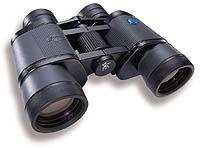
Binoculars with 6-mm exit pupils are unfortunately much rarer than the standard 7-mm ones, though it’s getting better. For example, Celestron produce a 7×42, and an 8×50. If sky conditions are too bright you can always stop down the objective lens to give better contrast.
The apparent field of view
The apparent field of view is governed by the eyepiece design. You can derive it from the product of the magnification and the true field of view. So for example a 10×50 binocular with a 6° true field, has an apparent field of 60° . A wide field of view will encompass more of the sky, and hence you will see more meteors. The recommended range is 45° to 70° , with 50° to 60° being preferred. You may be wondering why set an upper limit. One of the principal reasons for observing telescopic meteors is to investigate radiant properties by plotting meteor paths accurately. As the apparent field of view enlarges, the average plotting accuracy goes down. So ultra-wide fields (>65° ) are best for determining fluxes, and hence deriving the time of maximum for a shower; whereas around 50° rates are still reasonable (because the eye perceives only a fraction of the meteors in the outer >15° annulus) and accurate positional data can be obtained. Given the choice between the two, you should err on the side of the smaller apparent field as it offers more flexibility and science. Also ultra-wide eyepieces or binoculars are either very expensive if they give pinpoint images across the entire field, or give increasingly distorted images towards the periphery of the field. Below 50° the loss of sky coverage starts to become important. If rates become too low boredom and loss of concentration can soon set in.
Binocular versus telescope
Binocular vision is the natural way to look, and since comfort is a critical consideration for the telescopic observer, a binocular is preferred to a (monocular) telescope. There has been debate in the literature by how much it improves the limiting magnitude from nothing to about a magnitude. A telescope with a star diagonal is more flexible for viewing fields close to the zenith, and if you want a larger aperture, will be far less expensive. Angled binoculars only seem to come with large apertures and even larger price tags.
Aperture
This is less critical, and IMO observers’ apertures range from 40 to 300mm though most are in the range 50 to 80mm. Certain showers like the Perseids are progressively weaker towards fainter magnitudes and this suggests a small aperture is best, say a 6×30. Increasing the aperture increases the average meteor magnitude and so exaggerates any mass-sorting within the stream, and will give improved plotting accuracy. The intermediate apertures (50 to 80mm) look best.
Optical Quality
The quality of the optics can make a big difference to the performance. Remember that you’ll be observing for long periods and considerations like accurate collimation and pinpoint images will reduce strain. This consideration can outweigh some of those mentioned already. For example, a quality 7×42 binocular is going to let you see more meteors than say a cheap 8×50.
Conclusion
In conclusion an 8×50 or 10×60 binocular with a 55° apparent field would be excellent for telescopic meteors. Many other similar combinations will perform well too.