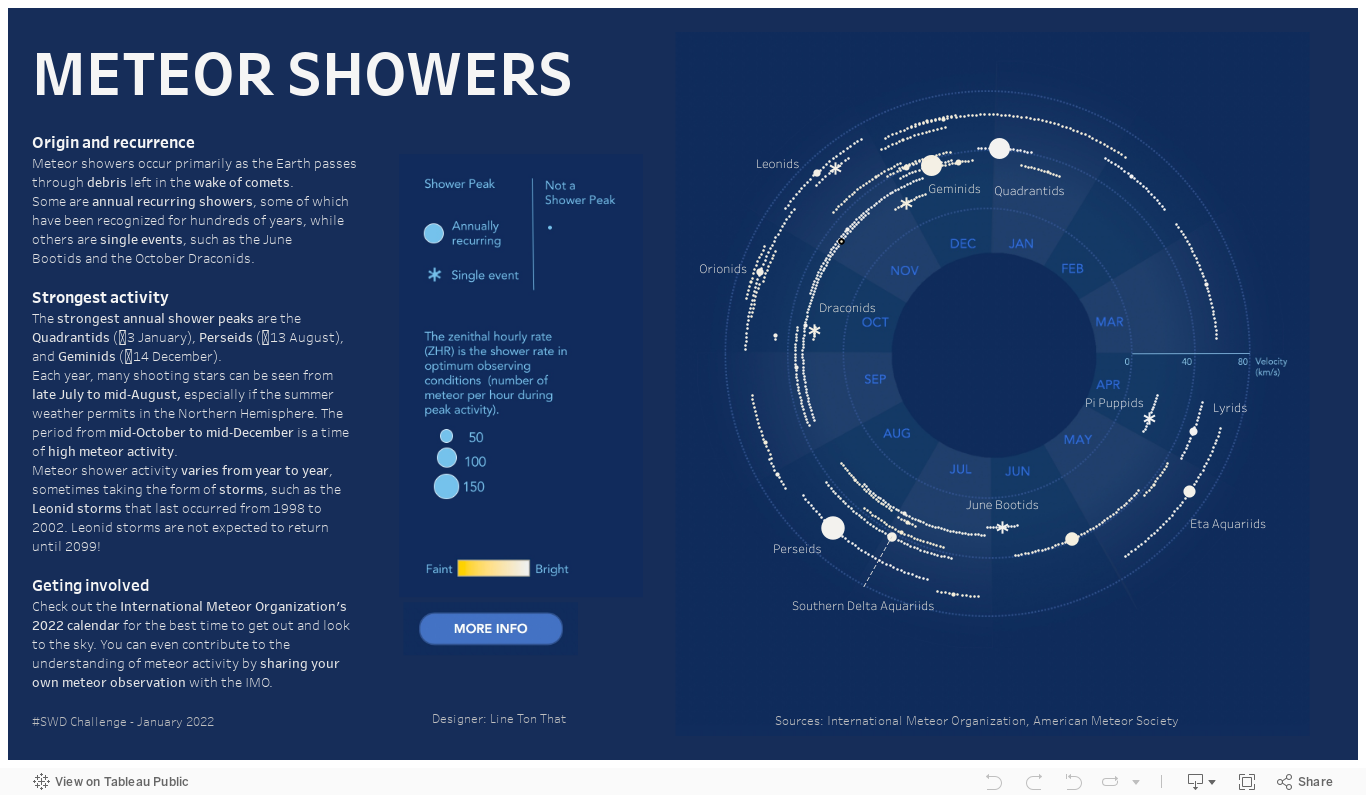
Welcome to the 2001 International Meteor Organization (IMO) Meteor Shower Calendar. The year promises some interesting Moon-free major showers, but the best southern ones are lost to moonlight along with the Perseids further north. The moonless Leonids may produce high to storm rates again this November, an interesting test for the various meteor stream theories, and skies will also be reasonably Moon-free for checking what the June Lyrids and June Bootids produce in mid and late June respectively. Do not forget that monitoring of meteor activity should ideally be carried on throughout the rest of the year too, however! We appreciate that this is not practical for many observers, and this Calendar was devised as a means of helping observers deal with reality by highlighting times when a particular effort may most usefully be employed. Although we include to-the-hour predictions for all the more active night-time and daytime shower maxima, based on the best available data, please note that in many cases, such maxima are not known more precisely than to the nearest 1° of solar longitude (even less accurately for the daytime radio showers, which have only recently begun to receive regular attention again). In addition, variations in individual showers from year to year mean past returns are at best only a guide as to when even major shower peaks can be expected, plus as some showers are known to show particle mass-sorting within their meteoroid streams, the radio, telescopic, visual/video and photographic meteor maxima may occur at different times from one another, and not necessarily just in these showers. The majority of data available are for visual shower maxima, so this must be borne in mind when employing other observing techniques.
The heart of the Calendar is the Working List of Visual Meteor Showers, thanks to regular updating from analyses using the IMO's Visual Meteor Database, the single most accurate listing available anywhere today for naked-eye meteor observing. Even this can never be a complete list of all meteor showers, since there are many showers which cannot be properly detected visually, and some which only photographic, radar, telescopic, or video observations can separate from the background sporadic meteors, present throughout the year.
The IMO's aims are to encourage, collect, analyze, and publish combined meteor data obtained from sites all over the globe in order to further our understanding of the meteor activity detectable from the Earth's surface. Results from only a few localized places can never provide such total comprehension, and it is thanks to the efforts of the many IMO observers worldwide since 1988 that we have been able to achieve as much as we have to date. This is not a matter for complacency, however, since it is solely by the continued support of many people across the whole world that our steps towards constructing a better and more complete picture of the near-Earth meteoroid flux can proceed. This means that all meteor workers, wherever they are and whatever methods they use to record meteors, should follow the standard IMO observing guidelines when compiling their information, and submit their data promptly to the appropriate Commission for analysis.
Visual and photographic techniques remain popular for nightly meteor coverage (weather permitting), although both suffer considerably from the presence of moonlight. Telescopic observations are much less popular, but they allow the fine detail of shower radiant structures to be derived, and they permit very low activity showers to be accurately detected. Video methods continue to be dynamically applied as in the last few years, and are starting to bear considerable fruit. These have the advantages, and disadvantages, of both photographic and telescopic observing, but are increasing in importance. Radio receivers can be utilized at all times, regardless of clouds, moonlight, or daylight, and provide the only way in which 24-hour meteor observing can be accomplished for most latitudes. Together, these methods cover virtually the entire range of meteoroid sizes, from the very largest fireball-producing events (using all-sky photographic patrols or visual observations) through to tiny dust grains producing extremely faint telescopic or radio meteors.
However and whenever you are able to observe, we wish you all a most successful year's work and very much look forward to receiving your data. Clear skies!
The year's first quarter brings several low activity showers, including the diffuse ecliptical stream complex of the Virginids, active from late January to mid-April. Of the major showers, the northern-hemisphere Quadrantids just survive the waxing Moon, but the southern-hemisphere alpha-Centaurids (maximum due around February 7, 22h UT) are lost to full Moon. The minor delta-Cancrids may peak on either January 11 (badly moonlit) or 17 (Moon-free till after local midnight), though the even weaker delta-Leonids in late February are much better-placed. In mid-March the gamma-Normids, with a maximum on March 13 or perhaps March 17 (this latter time based on 1999 data), are lost to moonlight in either case. Daylight radio peaks are theoretically due from the Capricornids/Sagittarids around 08h UT on February 1, and the chi-Capricornids on February 13, around 09h UT. Recent radio results suggest the Cap/Sgr maximum may fall 2-3 days later than this however, while no significant enhancement in radio rates was found near the expected chi-Capricornid peak between 1994-1999. As both showers have radiants <10°-15° west of the Sun at maximum, they cannot be regarded as visual targets even from the southern hemisphere.
Active : January 1-5; Maximum : January 3, 12h UT (lambda = 283.16°); ZHR = 120 (can vary around 60-200); Radiant : alpha = 230°, delta = +49°; Radiant drift: see Table 6; V = 41 km/s; r = 2.1 at maximum, but variable; TFC : alpha = 242°, delta = +75° and alpha = 198°, delta = +40° (beta>40° N); PFC : before 00h local time alpha = 150°, delta = +70°; after 00h local time alpha = 180°, delta = +40° and alpha = 240°, delta = +70° (beta>40° N). Figure 1: Radiant position and drift of the Quadrantids![]()
The year opens with a reasonable return of the Quadrantids for northern hemisphere observers, as the waxing gibbous Moon will set shortly after local midnight on January 2-3 and by 01h 30m on January 3-4. This is beneficial since the shower's radiant in northern Bootes is circumpolar for many northern locations, but attains a useful elevation only after local midnight, rising higher in the sky towards morning twilight. An interesting challenge is to try spotting the occasional long-pathed shower member from the southern hemisphere around dawn, but sensible Quadrantid watching cannot be carried out from such places.
The maximum time given above is based on the best-observed return of the shower ever analysed, in IMO 1992 data, confirmed by radio results in 1996, 1997 and 1999. A repeat of this time in 2001 would especially favor central and western North America. The peak itself is normally short-lived, and can be easily missed in just a few hours of poor northern-winter weather, which may be why the ZHR level apparently fluctuates from year to year, but some genuine variability is probably present too. For instance, visual ZHRs in 1998 persisted for over two hours at their best. An added level of complexity comes from the fact that mass-sorting of particles across the meteoroid stream may make fainter objects (radio and telescopic meteors) reach maximum several hours before the brighter (visual and photographic) ones, so observers should be alert throughout the shower.
Past observations have suggested the radiant is very diffuse away from the maximum, contracting notably during the peak itself, although this may be a result of the very low activity outside the hours near maximum. Photographic and video observations from January 1-5 would be particularly welcomed by those investigating this topic, using the PFCs and TFCs given above, along with telescopic and visual plotting results.
Active : February 15 - March 10; Maximum : February 24 (lambda = 336°); ZHR = 2; Radiant : alpha = 168°, delta = +16°; Radiant drift: see Table 6; V = 23 km/s; r = 3.0; TFC : alpha = 140°, delta = +37° and alpha = 151°, delta = +22° (beta>10° N); alpha = 140°, delta = -10° and alpha = 160°, delta = 0° (beta<10° N). Figure 2: Radiant position and drift of the delta-Leonids![]()
The resemblance of the delta-Leonids' orbits and that of the asteroid (4450) Pan might prove their distinguished origin apart from the general ecliptical (Virginid) background activity. Rates are normally low, and their meteors are predominantly faint, so the shower is a prime candidate for telescopic investigation. Visual observers must make very accurate plots of the meteors to distinguish them from the nearby Virginids and the sporadics. Northern hemisphere sites have an advantage for covering this stream, though southern hemisphere watchers should not ignore it, as they are better-placed to note many of the other Virginid radiants. The one-day-old Moon presents a perfect observing opportunity in 2001, and the delta-Leonid radiant is well on view for most of the night near its weekend peak.
Meteor activity picks up towards the April-May boundary, with shower peaks from the Moon-free Lyrids and pi-Puppids, and the brightly moonlit eta-Aquarids (maximum expected around May 5, 23h UT, but good rates may persist from about May 3-10, possibly with several sub-maxima). During May and June, most of the activity is in the daytime sky, with six shower peaks expected during this time. Although a few meteors from the omicron-Cetids and Arietids have been reported from tropical and southern hemisphere sites visually in past years, ZHRs cannot be sensibly calculated from such observations. For radio observers, the expected UT maxima for these showers are as follows:
April Piscids -- April 20, 08h UT; delta-Piscids -- April 24, 08h UT; epsilon-Arietids -- May 9, 06h UT; May Arietids -- May 16, 06h UT; o-Cetids -- May 20, 06h UT; Arietids -- June 7, 09h UT; zeta-Perseids -- June 9, 09h UT; beta-Taurids -- June 28, 08h UT.
Some signs of most of these peaks were found in data from 1994-1999, except the April Piscids and May Arietids. The visual ecliptical complexes continue with some late Virginids and the best from the minor Sagittarids in May-June. New Moon on June 21 should allow some monitoring of any possible June Lyrids or June Bootids this year.
Active : April 16-25; Maximum : April 22, 04h UT (lambda = 32.1°); ZHR = 15 (can be variable, up to 90); Radiant : alpha = 271°, delta = +34°; Radiant drift: see Table 6; V = 49 km/s; r = 2.9; TFC : alpha = 262°, delta = +16° and alpha = 282°, delta = +19° (beta>10° S). Figure 3: Radiant position of the Lyrids![]()
The Lyrids are best viewed from the northern hemisphere, but they are visible from many sites north and south of the equator, and are suitable for all forms of observation. Maximum rates are generally attained for only an hour or two at best, although in 1996, mean peak ZHRs of 15-20 persisted for around 8-12 hours. The ZHR can be rather erratic at times, a variability also seen in 1996, when rates ranged between 10-30 from hour to hour during the peak. The last high maximum occurred in 1982 over the USA, when a very short-lived ZHR of 90 was recorded. This unpredictability always makes the Lyrids a shower to watch, since we cannot say when the next unusual return may occur.
As the shower's radiant rises during the night, watches can be usefully carried out from about 22h 30m local time onwards. Perfect moonless conditions favor this year's mid-weekend display, with new Moon on April 23. The expected maximum should favor sites from extreme western Africa and the North Atlantic westwards to the eastern quarter of North America and the northern part of South America (where the radiant reaches a usable elevation) if correct, but variations in the stream could mean this is not the case in actuality.
Active : April 15-28; Maximum : April 23, 15h UT (lambda = 33.5°); ZHR = periodic, up to around 40; Radiant : alpha = 110°, delta = -45°; Radiant drift: see Table 6; V = 18 km/s; r = 2.0; TFC : alpha = 135°, delta = -55° and alpha = 105°, delta = -25° (beta<20° N). Figure 4: Radiant position of the pi-Puppids![]()
This is a young stream produced by Comet 26P/Grigg-Skjellerup, and shower activity has only been detected from it since 1972. Notable short-lived shower maxima of around 40 meteors per hour took place in 1977 and 1982, both years when the parent comet was at perihelion, but before 1982, little activity had been seen at other times. In 1983, a ZHR of about 13 was reported, perhaps suggesting that material has begun to spread further along the comet's orbit, as theory predicts. Comet Grigg-Skjellerup is next due at perihelion in October 2002, so good activity is unlikely this year. However, as the peak falls exactly on new Moon, it is a superb year to check whatever happens.
The shower is best-seen from the southern hemisphere, with useful observations mainly possible before local midnight, as the radiant is very low to setting after 01h local time. This means sites from central Australia west to India should be best-placed, if the maximum time proves correct. So far, visual and radio data have been collected on the shower, but the slow, bright nature of the meteors makes them ideal photographic subjects too. No telescopic or video data have been reported in any detail as yet either.
Active : June 11-21;
Maximum : June 16 (lambda = 85°);
ZHR = variable, 0 - 5;
Radiant : alpha = 278°, delta = +35°;
Radiant drift: June 10 alpha = 273°, delta = +35°,
June 15 alpha = 277°, delta = +35°,
June 20 alpha = 281°, delta = +35°;
V = 31 km/s;
r = 3.0;
Figure 5: Radiant position of the June Lyrids
This shower does not feature in the current IMO Working List of Visual Meteor Showers, as apart from some activity seen from northern hemisphere sites in a few years during the 1960s (first seen 1966) and 1970s, evidence for its existence has been virtually zero since. In 1996, several observers independently reported some June Lyrids, though no definite activity was subsequently found from 1997-1999 observations. The probable 2001 weekend maximum benefits from a waning crescent Moon, and we urge all observers who can to cover this possible stream. The radiant is a few degrees south of the bright star Vega (alpha Lyrae), so will be well on-view throughout the short northern summer nights, but there are discrepancies in its position in the literature. All potential June Lyrids should be carefully plotted, paying especial attention to the meteors' apparent velocity. Confirmation or denial of activity from this source by photography or video would be very useful too.
Active : June 26-July 2; Maximum : June 27, 07h UT (lambda = 95.7°); ZHR = variable, 0 - 100+; Radiant : alpha = 224°, delta = +48°; Radiant drift: see Table 6; V = 14 km/s; r = 2.2; TFC : alpha = 156°, delta = +64° and alpha = 289°, delta = +67° (beta=25..60° N). Figure 6: Radiant position and drift of the June Bootids![]()
Following the wholly unexpected strong return of this shower in 1998, when ZHRs of 50-100+ were visible for more than half a day, we reintroduced this source to the Working List of Visual Meteor Showers, and encourage all observers to routinely monitor the expected activity period in case of future outbursts. Prior to 1998, only three definite returns of the shower had been detected, in 1916, 1921 and 1927, and with no significant reports between 1928-1997, it seemed probable the stream no longer encountered Earth. The dynamics of the stream are poorly understood. The shower's parent comet 7P/Pons-Winnecke was last at perihelion in January 1996 and is next due in May 2002. Its orbit currently lies around 0.24 astronomical units outside the Earth's at its closest approach, so the 1998 return resulted from a stream on a different orbit to the comet's, thus we have no way at present to predict any future June Bootid activity. The radiant is at a useful elevation for most of the short summer night in the northern hemisphere (only), and the setting crescent Moon will give dark skies after 23h 30m to midnight local time on June 26-27.
The minor Pegasid (maximum July 9) and July Phoenicid (peak July 13) showers are both lunar casualties this year, but other minor shower activity continues apace from various near-ecliptic sources throughout the quarter, first from the Sagittarids, then the Aquarids and Capricornids, and finally the Piscids into September. The two strongest sources both suffer from the waxing gibbous Moon, the Southern delta-Aquarids (maximum on July 28, along with the minor Piscis Austrinids) and the alpha-Capricornids (peak on July 30). Moonset marginally favors more northerly sites for these, but their radiant declinations do not. The Southern iota-Aquarid and Northern delta-Aquarid maxima (August 4 and 8 respectively) are even worse-placed with full Moon on August 4. Even the Perseids are badly hit by an early-rising last quarter Moon, with maxima expected near 14h and 17h UT on August 12. The former was next to non-existing in 2000 data, indicating the vanishing influence of fresh cometary material ejected in 1862 on the activity profiles of the next years. At least the kappa-Cygnid and very weak Northern iota-Aquarid maxima fall in dark skies. The next full Moon on September 2 then helps ruin the best from both the alpha- (September 1, 00h UT) and delta-Aurigids (around September 8)! For daylight radio observers, the interest of May-June has waned, but there remain the visually-inaccessible gamma-Leonids (peak circa August 25d 09h UT, though not found in recent radio results), and a tricky visual shower, the Sextantids (maximum expected at September 27d 09h UT, but possibly occurring a day earlier. In 1999 a strong return was detected at lambda = 186°, equivalent to 2001 September 29). The waxing Moon will present no problems for visual observers trying to catch some Sextantids in late September, though the radiant rises less than an hour before dawn in either hemisphere.
Active : August 3-25; Maximum : August 17, (lambda = 145°); ZHR = 3; Radiant : alpha = 286°, delta= +59°; Radiant drift: see Table 6; V = 25 km/s; r = 3.0; TFC : alpha = 330°, delta = +60° and alpha = 300°, delta = +30° (beta> 20° N). Figure 7: Radiant position of the kappa-Cygnids![]()
New Moon on August 19 presents no difficulties during the expected kappa-Cygnid peak this year, but the shower is chiefly accessible from the northern hemisphere only. Its r-value suggests telescopic and video observers may benefit from its presence, but visual and photographic workers should note that occasional slow fireballs from this source have been reported too. Its almost stationary radiant results from its close proximity to the ecliptic north pole in Draco. There has been some suggestion of a variation in its activity at times, perhaps coupled with a periodicity in fireball sightings, but more data are urgently needed on a shower that often is ignored in favor of the Perseids during August.
Active : August 11-31; Maximum : August 19 (lambda = 147°); ZHR = 3; Radiant : alpha = 327°, delta = -6°; Radiant drift: see Table 6; V = 31 km/s; r = 3.2; TFC : alpha = 255° to 0°, delta = 0° to +15°, choose pairs separated by about 30° in alpha (beta<40° N). Figure 8: Radiant position of the Southern and Northern iota-Aquarids![]()
The complex of July-August Aquarid showers are all rich in faint meteors generally, making them well suited to telescopic work. As moonlight favors only this very ill-known peak from the complex this year, 2001 is a good chance for some useful data collection on it. An ill-defined maximum between lambda = 148°-151° was found in 1988-1995 visual results, which could mean the highest rates (even so, very weak) happen several days after the suspected peak time given here. Careful visual plotting is essential to define potential shower members for non-instrumental watchers.
Active : September 1-30; Maximum : September 19, (lambda = 177°); ZHR = 3; Radiant : alpha = 5°, delta= -1°; Radiant drift: see Table 6; V = 26 km/s; r = 3.0; TFC : alpha = 340° to 20°, delta = -15° to +15°, choose pairs separated by about 30° in alpha (beta any). Figure 9: Radiant position of the Piscids![]()
The Piscids are another poorly studied minor shower, with a peak radiant very close to the March equinox point in the sky. Consequently, they can be observed equally well from either hemisphere throughout the night near the September equinox, close to their probable maximum. This year, new Moon falls just two days before this time, but there is some doubt as to exactly when the Piscid peak may occur - or indeed, if there is only the one. Telescopic and video methods can be usefully employed to study it, along with methodical visual plotting.
Early October's waning gibbous Moon allows only a short period before moonrise to cover any potential Draconid activity (which might peak at some stage between October 8, 07h UT to October 9, 00h UT, based on results from 1998 and 1999, if anything at all happens), so observing will be very difficult. October's new Moon makes the epsilon-Geminids and Orionids extremely favorable however. Ecliptical minor shower activity reaches another peak in early to mid November, thanks to the Taurids. Unfortunately, the Southern Taurid maximum (November 5) and the interesting late October to early November period which sometimes produces more Taurid fireballs, are both badly affected by November's first full Moon, so this will not be a good year to check for a repeat of the unusual Taurid activity seen in late October 1998, when ZHRs reached levels comparable to the usual maximum rates. The Northern Taurid peak (November 12) is more usefully moonless. Another Leonid storm may occur later in November, and will be Moon-free if so, as will be the alpha-Monocerotid peak. The chi-Orionid maximum (December 2) loses out as November's second full Moon wanes. Pre-moonrise Phoenicid checking should be possible in early December, but useful late-night Puppid-Velid watching then will still be hampered by the waning Moon. The other December showers all have maxima reasonably to well clear of moonlight interference in 2001.
Active : October 14-27; Maximum : October 18, (lambda = 205°); ZHR = 2; Radiant : alpha = 102°, delta = +27°; Radiant drift: see Table 6; V = 70 km/s; r = 3.0; TFC : alpha = 90°, delta = +20° and alpha = 125°, delta = +20° (beta>20° S).
A weak minor shower with characteristics and activity nearly coincident with the Orionids, so great care must be taken to separate the two sources by instrumental techniques - especially video or telescopic work - or visual plotting. New Moon on October 16 presents an excellent opportunity to obtain more data on them from either hemisphere, although northern observers have an advantage, and can usefully access the radiant from about midnight onwards.
Active : October 2 - November 7; Maximum : October 21, 08h UT (lambda = 208°); ZHR = 20; Radiant : alpha = 95°, delta = +16°; Radiant drift: see Table 6; V = 66 km/s; r = 2.9; TFC : alpha = 100°, delta = +39° and alpha = 75°, delta = +24° (beta>40° N); or alpha = 80°, delta = +1° and alpha = 117°, delta = +1° (beta<40° N). Figure 10: Radiant position of the Orionids and epsilon-Geminids![]()
October's waxing crescent Moon enhances the Orionids this year too. They are noted for having several maxima other than the main weekend one detailed above, with activity sometimes remaining almost constant for several consecutive nights centred on this peak. In 1993 and 1998, a submaximum as strong as the normal peak was detected on October 17-18 from Europe, for instance. All observers should be aware of these possibilities. Several subradiants have been reported in the past, but recent video work suggests the radiant is far less complex; photographic, telescopic and video work to confirm this would be useful, as visual observers have clearly had problems with this shower's radiant determination before. With a radiant almost on the celestial equator, the shower can be seen from most of the globe, and observations are possible from midnight onwards in both hemispheres, perhaps a little before in the north.
Active : November 14-21; Maximum : November 17, 13h UT (lambda = 235.27°, nodal passage), but see accompanying text; ZHR = storm (about 360? in 1998, about 3700 in 1999, may reach storm level again in 2001); Radiant : alpha = 153°, delta = +22°; Radiant drift: see Table 6; V = 71 km/s; r = 2.9; TFC : alpha = 140°, delta = +35° and alpha = 129°, delta = +6° (beta>35° N); or alpha = 156°, delta = -3° and alpha = 129°, delta = +6° (beta<35° N); PFC : before 00h local time alpha = 120°, delta = +40° (beta>40° N); before 04h local time alpha = 120°, delta = +20° (beta>0° N); and after 04h local time alpha = 160°, delta = 0° (beta>0° N); before 04h local time alpha = 120°, delta = +10° (beta<0° N) and after 04h local time alpha = 160°, delta = -10° (beta<0° N). Figure 11: Radiant position and drift of the Leonids![]()
The Leonids' parent comet, 55P/Tempel-Tuttle, reached perihelion last in 1998 February, and a storm was well-seen in 1999 from the Near East westwards to the Canary Isles, but recent stream evolution studies suggest high to storm-level Leonid activity may still occur in 2001 or 2002. There are no guarantees that this will happen, but even observing an absence of unusual Leonid activity would be valuable information, though not very interesting to witness! The peak time given above is based on the Earth's closest approach to the comet's node. The 1999 storm peaked lambda = 0.035° (50 minutes) later than this nodal time then. However, other predictions based on different meteor stream filament theories for 2001 suggest maxima at: November 17, 16h 30m UT (Ignacio Ferrin; ZHR about 350); November 18, 10h 01m UT (ZHR about 2500?), 17h 31m UT (ZHR about 9000?) or 18h 19m UT (ZHR about 15000?; these latter three by David Asher and Rob McNaught); or November 18, 16h 54m UT (Peter Brown). Peter Brown's work further suggests a possible bright meteor peak around November 18, 11h UT. Any or all of these are liable to be amended following the 2000 Leonid return, and the IMO's journal WGN will have updates after that occurs.
The radiant rises only around local midnight (or indeed afterwards south of the equator), so the waxing crescent Moon will present no problems at all. The two November 17 peak timings would favor locations from west-central North America westwards to the extreme east of Russia (13h UT) or Alaska and Oceania westwards to eastern Asia (16h 30m UT). The various November 18 timings would be best for sites in North and Central America (10h-11h UT), eastern Asia and Australasia (17h-18h UT), or western Australia westwards to central Asia (18h UT). Even minor variations from these timings would mean places outside these zones may see something of the shower's best too. For instance in 1999, a resurgence producing ZHRs about 180 occurred some 13-14 hours after the main storm peak, and rates remained above the ZHR = 1000 storm level for over an hour near the storm's height. ZHRs were above 50 for more than a day nearest the main peak too, so even non-storm activity is worth seeing. All observing methods should be utilized, especially photography and video if another storm manifests.
Active : November 15-25; Maximum : November 21, 14h 20m UT (lambda = 239.32°); ZHR = variable, usually around 5 but may produce outbursts to around 400+; Radiant : alpha = 117°, delta = +1°; Radiant drift: see Table 6; V = 65 km/s; r = 2.4; TFC : alpha = 115°, delta = +23° and alpha = 129°, delta = +20° (beta>20° N); or alpha = 110°, delta = -27° and alpha = 98°, delta = +6° (beta<20° N); Figure 12: Radiant position and drift of the alpha-Monocerotids![]()
Another late-year shower capable of producing surprises, the alpha-Monocerotids gave their most recent brief outburst in 1995 (the top EZHR, about 420, lasted just five minutes; the entire outburst 30 minutes). Many observers across Europe witnessed it, and we have been able to completely update the known shower parameters as a result. Whether this indicates the proposed ten-year periodicity in such returns is real or not, only the future will tell, so all observers should continue to monitor this source closely. We are currently near the mid-point of any decade-long cycle. The waxing crescent Moon on November 21 makes this a splendid year for such scrutiny, as it will have set before the radiant is well on view from either hemisphere after about 23h local time (but note moonset is after midnight on November 21-22 for sites south of -30° latitude). The expected peak time falls especially well for sites from Alaska to extreme eastern Russia and Japan, including Australia, New Zealand and most of the central and western Pacific Ocean.
Active : November 28-December 9; Maximum : December 6, 7h UT (lambda = 254.25°); ZHR = variable, usually 3 or less, may reach 100; Radiant : alpha = 018°, delta = -53°; Radiant drift: see Table 6; V = 18 km/s; r = 2.8; TFC : alpha = 040°, delta = -39° and alpha = 065°, delta = -62° (beta<10° N). Figure 13: Radiant position of the Phoenicids![]()
Only one impressive Phoenicid return has so far been reported, that of its discovery in 1956, when the ZHR was about 100. Three other potential bursts of lower activity have been reported, but never by more than one observer, under uncertain circumstances. Reliable IMO data shows recent activity to be virtually nonexistent. This may be a periodic shower however, and more observations of it are needed by all methods. Radio workers may find difficulties, as radar echoes from the 1956 event were only 30 per hour, perhaps because these low-velocity meteors produce too little radio-reflecting ionization. Observing conditions this year are reasonable for all southern hemisphere watchers, with the waning gibbous Moon not rising until around 23h-00h local time on December 6, while the radiant is well on view for most of the night, but culminates at dusk.
Active : November 27-December 17; Maximum : December 9 (lambda = 257°); ZHR = 3; Radiant : alpha = 100°, delta = +8°; Radiant drift: see Table 6; V = 42 km/s; r = 3.0; TFC : alpha = 088°, delta = +20° and alpha = 135°, delta = +48° (beta>40° N); or alpha = 120°, delta = -03° and alpha = 84°, delta = +10° (beta<40° N);
Only low visual rates are likely from this minor source, making accurate visual plotting, telescopic or video work essential, particularly because the meteors are normally faint. The shower's details, including even its radiant position, are rather uncertain. Recent IMO data shows only weak signs of a maximum as indicated above. Telescopic data suggests a later maximum, around December 15 (lambda around 264°) from a radiant at alpha = 117°, delta = +20°. This is a moderate year for making observations, as the Moon rises within about 20 minutes of 01h local time (rising later south of the equator) on December 8-9. The radiant is on-show nearly all night, but culminates about moonrise.
Active : December 03-15; Maximum : December 11 (lambda=260°); ZHR = 2; Radiant : alpha=127°, delta=+02°; Radiant drift: see Table 6; V = 58 km/s; r = 3.0; TFC : alpha=095°, delta=00° and alpha=160°, delta=00° (all sites, after midnight only). Figure 14: Radiant position of the sigma-Hydrids![]()
Although first detected in the 1960s by photography, sigma-Hydrids are typically swift and faint, and rates are generally very low, close to the visual detection threshold. Since their radiant, a little over 10° east of the star Procyon (alpha Canis Minoris), is near the equator, all observers can cover this shower. The radiant rises in the late evening hours, but is best viewed after local midnight, so the waning crescent Moon will be little problem, as it rises about the start of morning twilight on December 11-12. Recent data indicates the peak may occur up to six days earlier than suggested above, which would be much less favorable for moon-free watching. The shower would benefit from visual plotting, telescopic or video work to pin it down more accurately.
Active : December 7-17; Maximum : December 14, 04h UT (lambda = 262.2°); ZHR = 120; Radiant : alpha = 112°, delta = +33°; Radiant drift: see Table 6; V = 35 km/s; r = 2.6; TFC : alpha = 87°, delta = +20° and alpha = 135°, delta = +49°; before 23h local time, alpha = 87°, delta = +20° and alpha = 129°, delta = +20° after 23h local time (beta>40° N); alpha = 120°, delta = -3° and alpha = 84°, delta = +10° (beta<20° N); PFC : alpha = 150°, delta = +20° and alpha = 60°, delta = +40° (beta>20° N); and alpha = 135°, delta = -5° and alpha = 80°, delta = 0° (beta<20° N) Figure 15: Radiant position of the Geminids and Monocerotids![]()
One of the finest annual showers presently observable, whose peak falls perfectly for new Moon this year. Well north of the equator, the radiant rises around sunset, and is at a usable elevation from the local evening hours onwards. In the southern hemisphere, the radiant appears only around local midnight or so. Even here, this is a splendid shower of often bright, medium-speed meteors, a rewarding sight for all watchers. The peak has shown slight signs of variability in its maximum rates and the actual peak timing in recent years. The six most reliably observed maxima over the past twelve years have all occurred between lambda = 262.1°-262.3° (ZHRs 110-130), which timings equate to 2001 December 14, 01h 30m to 06h 30m UT. The peak time of 04h UT above is the more probable, and especially favors sites from Europe west to eastern North America if correct. Some mass-sorting within the stream means the fainter telescopic meteors should be most abundant almost 1° of solar longitude (about one day) ahead of the visual maximum, with telescopic results indicating these meteors radiate from an elongated region, perhaps with three sub-centres. Further results on this topic would be useful, but all observing methods can be employed to observe the shower.
Active : December 12 - January 23; Maximum : December 19, (lambda = 268°); ZHR = 5; Radiant : alpha = 175°, delta = +25°; Radiant drift: see Table 6; V = 65 km/s; r = 3.0; TFC : alpha = 180°, delta = +50° and alpha = 165°, delta = +20° before 03h local time; or alpha = 195°, delta = +10° and alpha = 200°, delta = +45° after 03h local time (beta>20° N). Figure 16: Radiant position of the Coma Berenicids![]()
A weak minor shower that is usually observed only during the Geminid and Quadrantid epochs, but which needs more coverage at other times too, especially to better-define its maximum. The shower is almost unobservable from the southern hemisphere, so northern watchers must brave the winter cold to improve our knowledge of it, especially this year as its expected peak benefits from an early-setting waxing crescent Moon. The radiant is at a useful elevation from local midnight onwards.
Active : December 17-26; Maximum : December 22, 12h UT (lambda = 270.7°); ZHR = 10 (occasionally variable up to 50); Radiant : alpha = 217°, delta = +76°; Radiant drift: see Table 6; V = 33 km/s; r = 3.0; TFC : alpha = 348°, delta = +75° and alpha = 131°, delta = +66° (beta>40° N); alpha = 63°, delta = +84° and alpha = 156°, delta = +64° (beta 30° to 40° N); Figure 17: Radiant position of the Ursids![]()
A very poorly-observed northern hemisphere shower, but one which has produced at least two major outbursts in the past 60 years, in 1945 and 1986. Several other rate enhancements, recently in 1988 and 1994, have been reported too. Other similar events could easily have been missed due to poor weather or too few observers active. All forms of observation can be used for the shower, since many of its meteors are faint, but with so little work carried out on the stream, it is impossible to be precise in making statements about it. The radio maximum in 1996 occurred around lambda = 270.8°, for instance, which might suggest a slightly later maximum time in 2001 of December 22, 15h UT. The Ursid radiant is circumpolar from most northern sites (thus fails to rise for most southern ones), though it culminates after daybreak, and is highest in the sky later in the night. The first quarter Moon will set around midnight on December 22, giving dark skies for observations after this, favoring sites from central North America to the north-central Pacific Ocean.
If you are not observing during a major-shower maximum, it is essential to associate meteors with their radiants correctly, since the total number of meteors will be small for each source. Meteor plotting allows shower association by more objective criteria after your observation than the simple imaginary back-prolongation of paths under the sky. With meteors plotted on gnomonic maps, you can trace them back to their radiants by extending their straight line paths. If a radiant lies on another chart, you should find common stars on an adjacent chart to extend this back-prolongation correctly.
How large a radiant should be assumed for shower association? The real physical radiant size is very small, but visual plotting errors cause many true shower meteors to miss this real radiant area. Thus we have to assume a larger effective radiant to allow for these errors. Unfortunately, as we enlarge the radiant, so more and more sporadic meteors will appear to line up accidentally with this region. Hence we have to apply an optimum radiant diameter to compensate for the plotting errors loss, but which will not then be swamped by sporadic meteor pollution. Table 1 gives this optimum diameter as a function of the distance of the meteor from the radiant.
D optimum
diameter
15° 14°
30° 17°
50° 20°
70° 23°
The path-direction is not the only criterion for shower association. The angular velocity of the meteor should match the expected speed of the given shower meteors according to their geocentric velocities. Angular velocity estimates should be made in degrees per second (°/s). To do this, make the meteors you see move for one second in your imagination at the speed you saw them. The path length of this imaginary meteor is the angular velocity in °/s. Note that typical speeds are in the range 3°/s to 25°/s. Typical errors for such estimates are given in Table 2.
angular velocity °/s 5 10 15 20 30 permitted error °/s 3 5 6 7 8
In you found a meteor which hits the radiant within the above diameter, check its angular velocity. Table Table 3 gives the angular speeds for a few geocentric velocities, which can be looked up in Table 5 for each shower.
V=25 km/s V=40km/s V=60km/s
D 10° 20° 40° 60° 90° 10° 20° 40° 60° 90° 10° 20° 40° 60° 90°
10° 0.4 0.9 1.6 2.2 2.5 0.7 1.4 2.6 3.5 4.0 0.9 1.8 3.7 4.6 5.3
20° 0.9 1.7 3.2 4.3 4.9 1.4 2.7 5.0 6.8 7.9 1.8 3.5 6.7 9.0 10.0
40° 1.6 3.2 5.9 8.0 9.3 2.6 5.0 9.5 13.0 15.0 3.7 6.7 13.0 17.0 20.0
60° 2.2 4.3 8.0 11.0 13.0 3.5 6.8 13.0 17.0 20.0 4.6 9.0 17.0 23.0 26.0
90° 2.5 4.9 9.3 13.0 14.0 4.0 7.9 15.0 20.0 23.0 5.3 10.0 20.0 26.0 30.0
alpha, delta: Coordinates for a shower's radiant position, usually at maximum; alpha is right ascension, delta is declination. Radiants drift across the sky each day due to the Earth's own orbital motion around the Sun, and this must be allowed for using the details in Table 6 for nights away from the listed shower maxima.
r: Population index, a term computed from each shower's meteor magnitude distribution. r = 2.0-2.5 is brighter than average, while r above 3.0 is fainter than average.
lambda: Solar longitude, a precise measure of the Earth's position on its orbit which is not dependent on the vagaries of the calendar. All lambda are given for the equinox J2000.0.
V: Atmospheric or apparent meteoric velocity given in km/s. Velocities range from about 11 km/s (very slow) to 72 km/s (very fast). 40 km/s is roughly medium speed.
ZHR: Zenithal Hourly Rate, a calculated maximum number of meteors an ideal observer would see in perfectly clear skies with the shower radiant overhead. This figure is given in terms of meteors per hour. Where meteor activity persisted at a high level for less than an hour, or where observing circumstances were very poor, an estimated ZHR (EZHR) is used, which is less accurate than the normal ZHR.
TFC and PFC: suggested telescopic and photographic field centers respectively. beta is the observer's latitude ("<" means "south of" and ">" means "north of"). Pairs of telescopic fields must be observed, alternating about every half hour, so that the positions of radiants can be defined. The exact choice of TFC or PFC depends on the observer's location and the for video camera fields as well.
New First Full Last
Moon Quarter Moon Quarter
January 2 January 9 January 16
January 24 February 1 February 8 February 15
February 23 March 3 March 9 March 16
March 25 April 1 April 8 April 15
April 23 April 30 May 7 May 15
May 23 May 29 June 6 June 14
June 21 June 28 July 5 July 13
July 20 July 27 August 4 August 12
August 19 August 25 September 2 September 10
September 17 September 24 October 2 October 10
October 16 October 24 November 1 November 8
November 15 November 22 November 30 December 7
December 14 December 22 December 30
Shower Activity Maximum Radiant V r ZHR IMO
Period Date lambda alpha delta Code
° ° ° km/s
Quadrantids Jan 01-Jan 05 Jan 03 283.16 230 +49 41 2.1 120 QUA
delta-Cancrids Jan 01-Jan 24 Jan 17 297 130 +20 28 3.0 4 DCA
alpha-Centaurids Jan 28-Feb 21 Feb 08 319.2 210 -59 56 2.0 6 ACE
delta-Leonids Feb 15-Mar 10 Feb 24 336 168 +16 23 3.0 2 DLE
gamma-Normids Feb 25-Mar 22 Mar 13 353 249 -51 56 2.4 8 GNO
Virginids Jan 25-Apr 15 (Mar 24)(004) 195 -04 30 3.0 5 VIR
Lyrids Apr 16-Apr 25 Apr 22 032.1 271 +34 49 2.9 15 LYR
pi-Puppids Apr 15-Apr 28 Apr 23 033.5 110 -45 18 2.0 var. PPU
eta-Aquarids Apr 19-May 28 May 05 045.5* 338 -01 66 2.7 60 ETA}
Sagittarids Apr 15-Jul 15 (May 19)(059) 247 -22 30 2.5 5 SAG
June Bootids Jun 26-Jul 02 Jun 27 095.7 224 +48 18 2.2 var. JBO
Pegasids Jul 07-Jul 13 Jul 09 107.5 340 +15 70 3.0 3 JPE
July Phoenicids Jul 10-Jul 16 Jul 13 111 032 -48 47 3.0 var. PHE
Pisces Austrinids Jul 15-Aug 10 Jul 28 125 341 -30 35 3.2 5 PAU
Southern delta-Aquarids Jul 12-Aug 19 Jul 28 125 339 -16 41 3.2 20 SDA
alpha-Capricornids Jul 03-Aug 15 Jul 30 127 307 -10 25 2.5 4 CAP
Southern iota-Aquarids Jul 25-Aug 15 Aug 04 132 334 -15 34 2.9 2 SIA
Northern delta-Aquarids Jul 15-Aug 25 Aug 08 136 335 -05 42 3.4 4 NDA
Perseids Jul 17-Aug 24 Aug 12 139.8 046 +58 59 2.6 110 PER
kappa-Cygnids Aug 03-Aug 25 Aug 17 145 286 +59 25 3.0 3 KCG
Northern iota-Aquarids Aug 11-Aug 31 Aug 19 147 327 -06 31 3.2 3 NIA
alpha-Aurigids Aug 25-Sep 05 Sep 01 158.6 084 +42 66 2.5 10 AUR
delta-Aurigids Sep 05-Oct 10 Sep 08 166 060 +47 64 3.0 6 DAU
Piscids Sep 01-Sep 30 Sep 19 177 005 -01 26 3.0 3 SPI
Draconids Oct 06-Oct 10 Oct 08 195.4 262 +54 20 2.6 var. GIA
epsilon-Geminids Oct 14-Oct 27 Oct 18 205 102 +27 70 3.0 2 EGE
Orionids Oct 02-Nov 07 Oct 21 208* 095 +16 66 2.9 20 ORI
Southern Taurids Oct 01-Nov 25 Nov 05 223 052 +13 27 2.3 5 STA
Northern Taurids Oct 01-Nov 25 Nov 12 230 058 +22 29 2.3 5 NTA
Leonids Nov 14-Nov 21 Nov 17 235.27 153 +22 71 2.5 storm? LEO
alpha-Monocerotids Nov 15-Nov 25 Nov 21 239.32 117 +01 65 2.4 var. AMO
chi-Orionids Nov 26-Dec 15 Dec 02 250 082 +23 28 3.0 3 XOR
Phoenicids Nov 28-Dec 09 Dec 06 254.25 018 -53 18 2.8 var. PHO
Puppid-Velids Dec 01-Dec 15 (Dec 07)(255) 123 -45 40 2.9 10 PUP
Monocerotids Nov 27-Dec 17 Dec 09 257 100 +08 42 3.0 3 MON
sigma-Hydrids Dec 03-Dec 15 Dec 11 260 127 +02 58 3.0 2 HYD
Geminids Dec 07-Dec 17 Dec 14 262.0 112 +33 35 2.6 120 GEM
Coma Berenicids Dec 12-Jan 23 Dec 19 268 175 +25 65 3.0 5 COM
Ursids Dec 17-Dec 26 Dec 22 270.7 217 +76 33 3.0 10 URS
COM DCA QUA
Jan 0 186 +20 112 +22 228 +50
Jan 5 190 +18 116 +22 231 +49
Jan 10 194 +17 121 +21
Jan 20 202 +13 130 +19 ACE VIR
Jan 30 200 -57 157 +16 DLE
Feb 10 214 -60 165 +10 155 +20 GNO
Feb 20 225 -63 172 +6 164 +18 225 -53
Feb 28 178 +3 171 +15 234 -52
Mar 10 186 0 180 +12 245 -51
Mar 20 192 -3 256 -50
Mar 30 198 -5
Apr 10 SAG LYR PPU 203 -7
Apr 15 224 -17 263 +34 106 -44 ETA 205 -8
Apr 20 227 -18 269 +34 109 -45 323 -7
Apr 25 230 -19 274 +34 111 -45 328 -5
Apr 30 233 -19 332 -4
May 5 236 -20 337 -2
May 10 240 -21 341 0
May 20 247 -22 350 +5
May 30 256 -23
Jun 10 265 -23
Jun 15 270 -23
Jun 20 275 -23 JBO
Jun 25 280 -23 223 +48
Jun 30 284 -23 225 +47 CAP JPE
Jul 5 289 -22 285 -16 SDA 338 +14
Jul 10 293 -22 PHE 289 -15 325 -19 NDA 341 +15 PER PAU
Jul 15 298 -21 032 -48 294 -14 329 -19 316 -10 012 +51 330 -34
Jul 20 299 -12 333 -18 319 -9 SIA 018 +52 334 -33
Jul 25 303 -11 337 -17 323 -9 322 -17 023 +54 338 -31
Jul 30 KCG 308 -10 340 -16 327 -8 328 -16 029 +55 343 -29
Aug 5 283 +58 NIA 313 -8 345 -14 332 -6 334 -15 037 +57 348 -27
Aug 10 284 +58 317 -7 318 -6 349 -13 335 -5 339 -14 043 +58 352 -26
Aug 15 285 +59 322 -7 352 -12 339 -4 345 -13 050 +59
Aug 20 286 +59 327 -6 AUR 356 -11 343 -3 057 +59
Aug 25 288 +60 332 -5 076 +42 347 -2 065 +60
Aug 30 289 +60 337 -5 082 +42 DAU
Sep 5 088 +42 055 +46 SPI
Sep 10 060 +47 357 -5
Sep 15 066 +48 001 -3
Sep 20 071 +48 005 -1
Sep 25 NTA STA 077 +49 009 0
Sep 30 021 +11 023 +5 ORI 083 +49 013 +2
Oct 5 025 +12 027 +7 085 +14 089 +49 GIA
Oct 10 029 +14 031 +8 088 +15 095 +49 EGE 262 +54
Oct 15 034 +16 035 +9 091 +15 099 +27
Oct 20 038 +17 039 +11 094 +16 104 +27
Oct 25 043 +18 043 +12 098 +16 109 +27
Oct 30 047 +20 047 +13 101 +16
Nov 5 053 +21 052 +14 105 +17
Nov 10 058 +22 056 +15 LEO AMO
Nov 15 062 +23 060 +16 150 +23 112 +2
Nov 20 067 +24 064 +16 XOR 153 +21 116 +1
Nov 25 072 +24 069 +17 075 +23 120 0 MON PUP PHO
Nov 30 080 +23 HYD 091 +8 120 -45 014 -52
Dec 5 COM GEM 085 +23 122 +3 096 +8 122 -45 018 -53
Dec 10 169 +27 108 +33 090 +23 126 +2 100 +8 125 -45 022 -53
Dec 15 173 +26 113 +33 094 +23 130 +1 URS 104 +8 128 -45
Dec 20 177 +24 118 +32 217 +75
Shower Activity Max lambda Radiant Best Observed Rate
Date 2000.0 al. de. 50°N 35°S
° ° °
Cap/Sagittarids Jan 13-Feb 04 Feb 01 312.5 299 -15 11h-14h 09h-14h medium
chi-Capricornids Jan 29-Feb 28 Feb 13 324.7 315 -24 10h-13h 08h-15h low
Piscids (Apr.) Apr 08-Apr 29 Apr 20 030.3 007 +7 07h-14h 08h-13h low
delta-Piscids Apr 24-Apr 24 Apr 24 034.2 011 +12 07h-14h 08h-13h low
epsilon-Arietids Apr 24-May 27 May 09 048.7 044 +21 08h-15h 10h-14h low
Arietids (May) May 04-Jun 06 May 16 055.5 037 +18 08h-15h 09h-13h low
omicron-Cetids May 05-Jun 02 May 20 059.3 028 -4 07h-13h 07h-13h medium
Arietids May 22-Jul 02 Jun 07 076.7 044 +24 06h-14h 08h-12h high
zeta-Perseids May 20-Jul 05 Jun 09 078.6 062 +23 07h-15h 09h-13h high
beta-Taurids Jun 05-Jul 17 Jun 28 096.7 086 +19 08h-15h 09h-13h medium
gamma-Leonids Aug 14-Sep 12 Aug 25 152.2 155 +20 08h-16h 10h-14h low
Sextantids Sep 09-Oct 09 Sep 27 184.3 152 0 06h-12h 06h-13h medium
Fireball Data Center : André Knöfel, Saarbrückerstraße 8,
(FIDAC) D-40476 Düsseldorf, Germany.
(e-mail: fidac@imo.net)
Photographic Commission: Marc de Lignie, Prins Hendrikplein 42,
NL-2264 SN Leidschendam, the Netherlands.
(e-mail: photo@imo.net)
Radio Commission: Temporarily vacant
(e-mail: radio@imo.net)
Telescopic Commission: Malcolm Currie, 660 N'Aohoku Place,
Hilo, HI 96720, U.S.A.
(e-mail: tele@imo.net)
Video Commission: Sirko Molau, Weidenweg 1,
D-52074 Aachen, Germany
(e-mail: video@imo.net)
Visual Commission: Rainer Arlt, Friedentraße 5,
D-14109 Berlin, Germany
(e-mail: visual@imo.net)
or contact IMO's Homepage in the World-Wide-Web: http://www.imo.net/
For further details on IMO membership, please write to:
Ina Rendtel, IMO Treasurer, Mehlbeerenweg 5,
D-14469 Potsdam, Germany.
(e-mail: treasurer@imo.net)
Please try to enclose return postage when writing to any IMO officials, either in the form of stamps (same country only) or as an International Reply Coupon (I.R.C. - available from main postal outlets). Thank you!